Skip to content
Three people in orange safety vests stand in a warehouse, looking at a clipboard and smiling while having a discussion.
Report/Research

Understanding Youth Movement from Pre-Apprenticeship to Registered Apprenticeship

Findings from JFF's Next-Generation Apprenticeship for Next Generation Talent Initiative

June 30, 2026

At a Glance

JFF shares outcomes and key learnings from its DOL-funded four-year initiative, Next-Generation Apprenticeship for Next-Generation Talent, to expand access to pre-apprenticeship and Registered Apprenticeship for young people, ages 16-24.

Contributors
Abra Beu Senior Analyst
Jennifer Meier Senior Manager
Myriam Sullivan Associate Vice President
Michael Sack Senior Director
Erin Bowes Coordinator
Practices & Centers

Introduction

The Jobs for the Future (JFF) Apprenticeship Building America (ABA) initiative, Next-Generation Apprenticeship for Next-Generation Talent, is part of a national investment by the U.S. Department of Labor (DOL) to strengthen, modernize, and expand the Registered Apprenticeship (RA) system. With grant funding from the U.S. DOL, JFF worked with partners across 24 states to build and expand pre-apprenticeship and Registered Apprenticeship programs (RAPs) that open high-quality pathways for in-school and out-of-school youth ages 16–24.

Grounded in a commitment to economic advancement, this work aimed to ensure that young people, regardless of their prior connections to education or work, can access, succeed in, and progress through apprenticeship opportunities that lead to family-sustaining careers.

JFF set ambitious goals for the Next-Generation Apprenticeship for Next-Generation Talent Initiative, designed to expand access to the apprenticeship system for youth and young adults, including:


Line drawing of a ruler, triangle, and pencil on top of an open laptop, all within a light blue circle background.

Launching 12 new RAPs and expanding 15 existing programs, as well as launching 15 new pre-apprenticeships and growing 10 existing pre-apprenticeship programs.

Outline of a light bulb combined with a human head and a gear, symbolizing ideas, innovation, and technical thinking, on a light blue circular background.

Expanding and strengthening pre-apprenticeship training as an effective on-ramp into RAPs for youth and young adults. These efforts were designed not only to increase the number of youth served, but also to spur the adoption of youth-centered program designs and local ecosystem models that braid education, workforce, and community resources in ways that meet young people where they are.

Line drawing of two people, one wearing glasses and casual clothes, the other in formal attire with a tie, on a light blue circular background.

Serving 1000 youth and young adult participants, with at least 400 enrolling in RAPs. This includes 900 pre-apprentices, of whom at least 300 were expected to continue into RAPs, and 100 young people who would enroll directly into RAP.

This report summarizes findings from research conducted to explore what characteristics influence whether young people move into RAPs, what outcomes youth experience through pre-apprenticeship participation beyond transition into RA, how program design, curriculum, and support services shape transition success and other outcomes, and what challenges and opportunities employers encounter when hiring graduates of pre-apprenticeship programs.

Hear from our partners and youth apprentices about the value of these pathways and how JFF helped accelerate their progress.

Program Outcomes at a Glance

As of February 2026, JFF’s ABA grant made important progress in expanding pathways for young people:

1,066
young people enrolled in pre-apprenticeship
801
of those enrolled completed their pre-apprenticeship program
8%
of those who completed their pre-apprenticeship program transitioned into Registered Apprenticeship

Program Reach

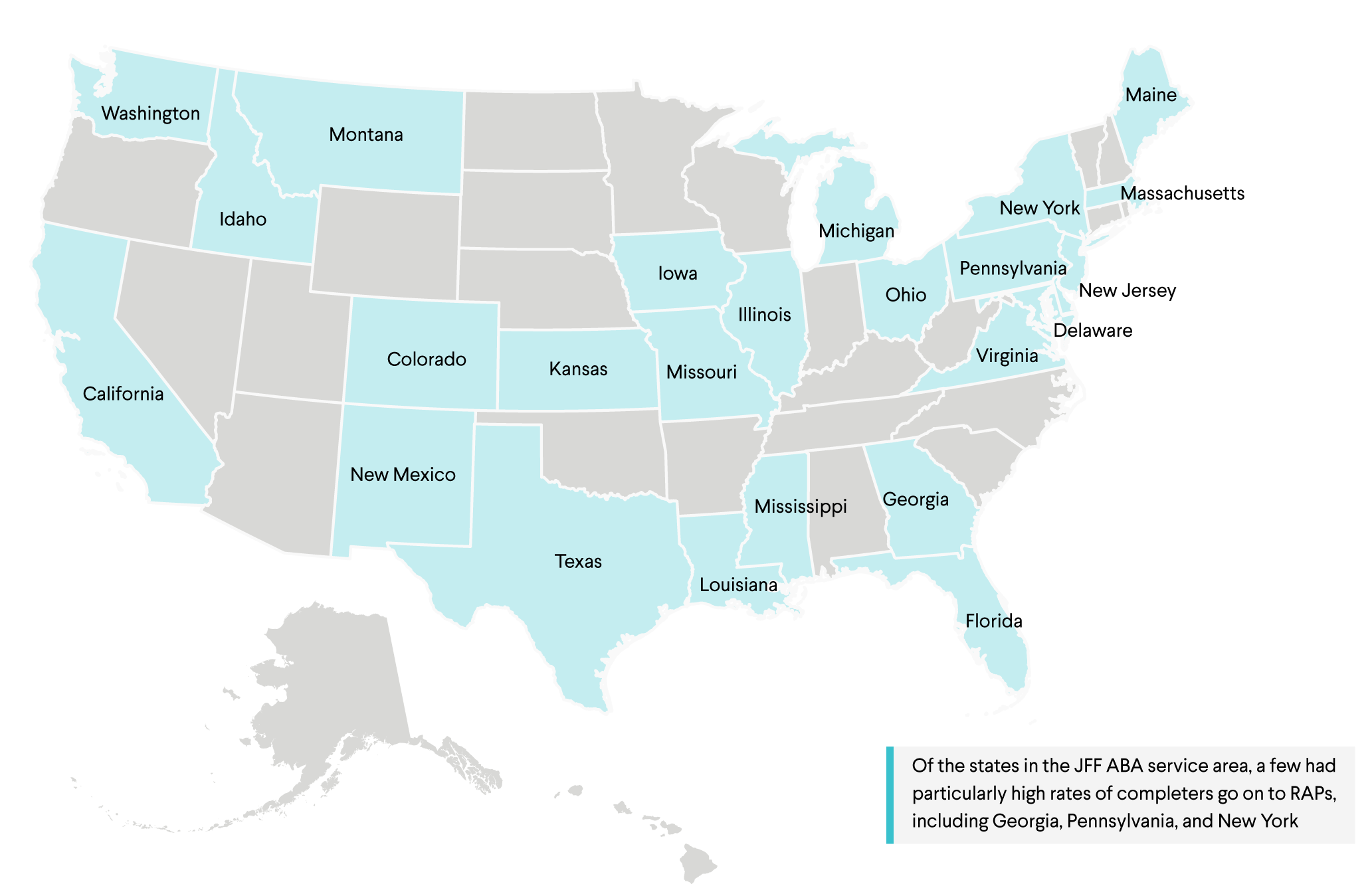
Through the ABA grant, JFF worked with partners across 24 states to build and expand pre-apprenticeship and RAPs that open high-quality pathways for in-school and out-of-school youth ages 16–24. Of the states in the JFF ABA service area, a few had particularly high rates of completers who went on to RAPs, including Georgia, Pennsylvania, and New York.

Map of the United States with 15 states highlighted in light blue, indicating states in the JFF ABA service area. Text notes Georgia, Pennsylvania, and New York as notable for RAP completers.

Partners

JFF was proud to partner with nine youth-serving organizations to expand access to pre-apprenticeship and RA to youth ages 16-24:

Hexagonal logo with "YB" at the top, "YouthBuild" in the center, and "American YouthWorks" below, all on a blue background with orange and white borders.
Catalyst Kitchens logo featuring a stylized orange and blue flame inside a gray circle, with "Catalyst Kitchens" written below in gray and orange text.
The image shows the words "Educate Maine" in large, bold, dark blue text on a white background.
Logo with a blue upward arrow containing the letter "F." Diagonal orange text reads "First Place for Youth." Below, smaller text says "More is Possible.
Goodwill of North Georgia logo featuring the word "Goodwill" in blue, "of North Georgia" in black, and the Goodwill smiling face icon in blue and black on the right.
JEVS Human Services logo with stylized text and an abstract human figure above the word "JEVS.
Logo with a shield and cross surrounded by a red laurel wreath. Text below reads "Legacy Institute for Financial Empowerment.
The Loop Lab logo with the word "LOOP" using two overlapping circles to form the double O.
Reach Higher Montana logo with a blue abstract human figure wearing a green graduation cap, and the text "Reach Higher Montana" in blue and green.

Partnership in Action

JFF Helps JEVS Build and Scale Apprenticeship Pathways

Learn more

Educate Maine Scales Apprenticeship Throughout the State

Learn more

Catalyst Kitchens: Building a National Movement for Trauma-Informed Culinary Training

Learn more

From Local Impact to Regional Growth: Goodwill of North Georgia’s Apprenticeship Expansion Strategy

Learn more

Measuring Impact: Our Research Study

This report summarizes findings from research conducted to explore answers to the following questions:

Participant Factors

What individual characteristics (e.g., demographics, prior experience, region, motivation) influence whether young people move into RA?

Pre-Apprenticeship Impact

What are the other outcomes for youth who participate in pre-apprenticeship programs outside of transitioning into RA?

Program Factors

How do program design, curriculum, and support services impact transition success and other outcomes?

Employer and Systemic Factors

What challenges and opportunities do employers face when hiring pre-apprenticeship graduates?

Data Sources

The following primary data sources informed these findings:

Pre-apprenticeship completer survey (youth)

An online survey was completed by 13 young people who had recently finished pre‑apprenticeship programs in fields such as health care, information technology, construction, automotive, maintenance, and office/software in multiple U.S. states.

Employer survey

An online survey was completed by 9 employers and supervisors from small and mid‑sized organizations in trades and marine/aquaculture‑related sectors in a single U.S. region. Respondents included direct supervisors, owners and managers, program supervisors, and human resources or hiring staff.

Pre-Apprenticeship to RA Pathway survey (practitioners)

A separate online survey was completed by 14 staff from pre‑apprenticeship, RA, and intermediary organizations working with youth ages 16–24. Respondents included regional managers, outreach directors, workforce development directors, participant services managers, and program managers. Sectors spanned health care, IT, construction, hospitality, warehousing/logistics, customer service and retail, aquaculture, automotive, banking, manufacturing, and others.

Administrative and survey data collected and summarized in AGS Prime

The team also examined administrative and survey data collected through AGS Prime that covered a larger cohort of pre‑apprentices, focusing on program status, RA progression, and basic demographics.

Qualitative interviews with youth, employers, and training providers

One youth interview with a participant in a healthcare‑focused pre‑apprenticeship program that combined classroom, lab‑based, and online instruction.

Two interviews with employer and training‑provider representatives, including a media and creative industries provider and a small arts venue that hosts technical apprentices.

Up Next

Key Learnings

Youth Council of Changemakers Recommendations

Looking Ahead

This project is funded by the U.S. Department of Labor, Employment and Training Administration, as part of the Apprenticeship Building America grant totaling $5,310,000, with $2,003,460 financed from non-federal sources.

Jobs for the Future (JFF) transforms U.S. education and workforce systems to drive economic success for people, businesses, and communities.