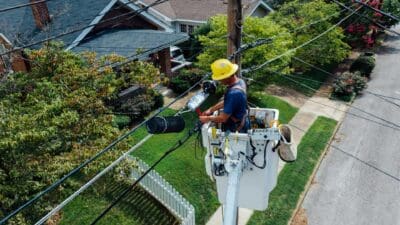
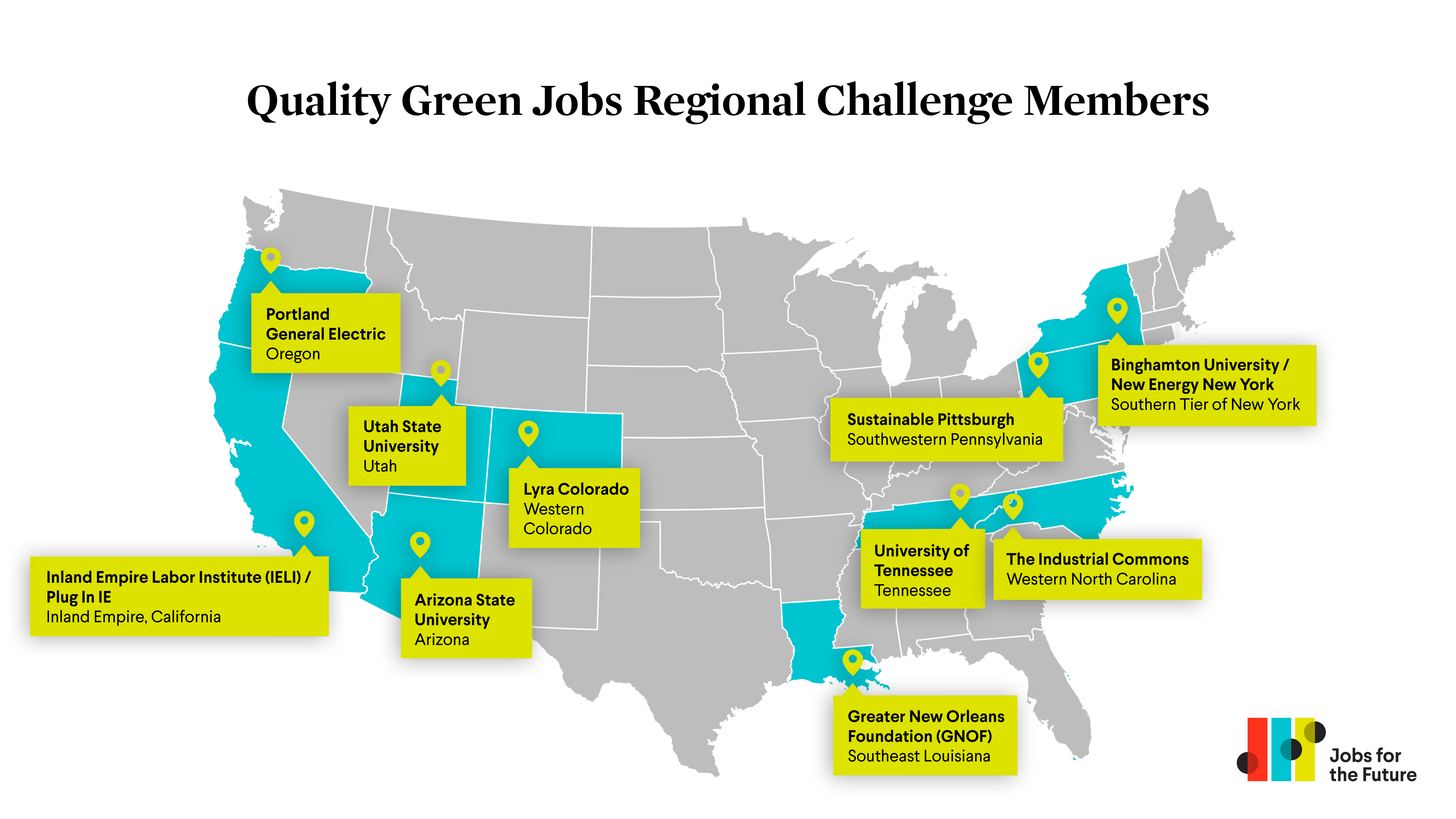
- Ensure paid work-based learning opportunities. Traditional educational routes may not always align with the evolving demands of green industries. Apprenticeship programs such as those offered at Portland General Electric’s Sherwood Training Center, offer a hands-on approach to learning infused with efforts to diversify the talent pipeline, such as covering the cost of tools, training, and a commercial driver’s license as well as working closely with community-based organizations and women’s trade association on a recruitment strategy.
- Engage with local political partners. Southwestern Pennslyvania’s Clean Energy Workforce Roundtable, established in 2021 and led by Sustainable Pittsburgh, is a diverse group of stakeholders deeply invested in the Pittsburgh region’s future. The coalition includes political stakeholders, such as the deputy chief of staff for Pittsburgh’s mayor, highlighting the strategic significance of local government partnerships. Southwestern Pennslyvania’s political partners support coordinated approaches to clean energy initiatives, especially aiming to leverage employer partnerships and access federal funding opportunities. The City of Pittsburgh’s mayor’s office plays a crucial role in initiatives such as the Pittsburgh Workforce Hub and the Pittsburgh Good Jobs Principles, ensuring industry commitments to training, equity, and accountability.
Challenge members in rural regions face barriers related to geographic isolation, limited economic opportunities, and aging infrastructure, which can exacerbate inequality and hinder social mobility, and those in urban areas contend with gentrification and racial segregation, highlighting the need for equitable development strategies and policies that benefit all residents. Across the board, lack of affordable housing also poses a challenge. Together, these challenges exacerbate the tremendous need for continuous wraparound supports for workers.
Providing ample and consistent wraparound support services that extend from training to career is essential to worker—and employer—success.
Wraparound services can significantly impact a person’s ability to engage in workforce development and retain employment. Tailoring them to communities’ needs reflects a holistic approach to worker success. In many cases, wraparound services for workers also increase profitability for employers. Telos Global, an advanced manufacturer and partner of the University of Tennessee, Knoxville, is known for its dedication to the well-being and career advancement of its employees. It provides a tuition reimbursement program, apprenticeships, and work-based learning opportunities. Additionally, it collaborates with local community colleges to enhance employee training and certification programs. While Telos is striving to do right by its employees, it has also made these investments to overcome recruitment and retention challenges, grow its business, and increase profitability.
It is also important to address the barriers that people may face in accessing and maintaining employment in quality jobs. Many challenge members are working with partners to provide wraparound support services such as career counseling, job placement assistance, transportation assistance, child care support, affordable housing, and financial literacy training. For the Inland Empire Labor Institute / Plug in IE, for instance, they and their partners emphasize the importance of financial literacy—the IUOE Local Union 12 offers a course on finances for trades workers, and Tradeswomen Sisterhood, an electrical pre-apprenticeship program for women founded by an organizer from IBEW Local 440, has financial literacy built into its curriculum.
Another method of rooting wealth locally and enabling personal financial success for individuals is affordable housing. The Industrial Commons is developing an Innovation Campus, which will house a manufacturing center, equipped for both skilled training and incubation, and a central business support building designed to enhance collaboration with its partners across the region. It has an adjacent parcel where 50 affordable housing units will be built under a limited equity co-operative model that can be an entry point into home ownership for workers as they build long-term wealth and stability.
Formalizing, certifying, and integrating green skills will support green job growth.
Challenge members emphasized the importance of both durable (soft) green skills and technical green skills. Additional credentials and certifications are needed to formalize and bring legitimacy to both durable and technical green skills, and challenge members emphasized the importance of industry-validated credentials and certifications that create tangible value for workers (such as additional compensation). Binghamton University is at the helm of New Energy New York (NENY), a dynamic and diverse coalition of more than 50 industry partners and 27 counties in upstate New York. Dedicated to propelling renewable energy initiatives forward, with the support of the Quality Green Jobs Regional Challenge, NENY is gearing up to create a standardized, open-source, extended reality (XR) battery safety and career readiness training program. This innovative endeavor aims to address existing gaps in the industry, ensuring comprehensive preparation for high-demand, quality jobs in the battery and energy storage sector. By elevating job standards for battery technicians nationwide, this initiative not only enhances career prospects but also fosters positive climate impacts through the promotion of sustainable energy practices.
Career and technical education (CTE) programs offer youth and adults promising pathways to high-wage, high-skill, high-demand careers nationwide. New green CTE programs and apprenticeship programs can and must be built, but several communities noted that this will require resources, community buy-in, and staffing that may be lacking locally. They suggested that there may be a more resource-efficient opportunity to integrate green skills (e.g., waste reduction) into existing CTE and apprenticeship programs.
This approach aligns with JFF’s assertion that all jobs can become greener through the integration of green knowledge and skills. Across geographies, a significant number of green job opportunities are emerging within existing industries and employers. In Colorado, a growing number of mom-and-pop HVAC contractors are seeking technicians with heat pump skills and experience, and increasingly in rural Appalachia, workers at advanced manufacturing plants are assembling parts for electric vehicles. In these examples, many of the core durable and technical skills remain the same, with a growing need for workers with green specializations that are denoted with additional credentials and certifications.
Finally, challenge members emphasized that if growing the green economy means growing skilled trades, then we must invest in rebranding the trades and diversifying outreach approaches to appeal to women and people of color.
Collecting and assessing varied data sources is essential to identifying true growth opportunities in the green economy.
Nearly every challenge member found a scarcity of data to be a significant barrier to identifying the biggest and most compelling growth opportunities for green jobs in their region. Even the most current labor market information is at least a year old and doesn’t take into consideration the billions of dollars designated to supporting the nation’s clean energy transition through the Inflation Reduction Act, the Bipartisan Infrastructure Law, and the CHIPS and Science Act.
Additionally, challenge members working in rural communities identified the need for hyper-local data to buttress the statewide and metropolitan statistical area data that is available through most data tools. Rural community leaders stressed the need to train youth and adults for jobs available in their communities—not 40 or more miles away. Understanding hyper-local labor market needs is essential not only to promulgating growth in the green economy, but also to reducing rural population loss and advancing rural economic development.
Additional green jobs data—and training about how to verify, collect, braid, and analyze various data sets—is essential to developing training programs that are aligned to local and national labor market needs.
José Lobo, a clinical associate professor at Arizona State University’s School of Sustainability proposed another solution: building a large language model that could help analyze the factors required for a clean energy transition and then identify the specific jobs—and, therefore, skills—needed to place workers in those quality jobs.
Building a skilled workforce capable of supporting green industries requires investments in education, training, and workforce development programs. The Quality Green Jobs Regional Challenge demonstrates how initiatives can equip individuals with necessary technical skills while driving holistic, regionally contextualized solutions. Solutions include access to employment opportunities and wraparound support services such as housing, transportation, and health care. Addressing these interconnected issues requires coordinated efforts across multiple sectors and disciplines. The Quality Green Jobs Regional Challenge members all have demonstrated the ability to build trusted, collaborative partnerships, provide capacity-building support, and promote sustainable practices, all of which hold equity at their core and drive toward a more resilient green economy.
JFF and the Ares Charitable Foundation are honored to support and champion our challenge members and look forward to continuing to disseminate findings to the broader field. Please stay in touch and follow along as we continue to discover regional quality green job strategies that drive equitable economic advancement for all.
The Climate Innovation incubation practice area at JFFLabs takes an inclusive approach to inform, educate, and upskill individuals for climate-resilient jobs through innovation and collaboration across sectors, regions, new business models, and capital investments.
Climate-Resilient Employees for a Sustainable Tomorrow (CREST) is a career-preparation and reskilling initiative of the Ares Charitable Foundation that aims to close the gap between the demand for a skilled workforce for green jobs and the number of people prepared for these opportunities.