Skip to content
Aerial view of a college campus, brick academic buildings, green lawns, walking paths, and surrounding trees.
Project

Increasing Dual Enrollment Access and Success (IDEAS)

December 17, 2025

At a Glance

IDEAS expands access to dual enrollment opportunities by piloting the hub model, connecting schools, colleges, and communities to ensure more students earn meaningful credits before graduation.

Contributors
Carly Martell Senior Manager
Ellen Bohle Senior Manager
Ronesha Jones Senior Manager
Practices & Centers

Dual enrollment, where high school students take college-level courses, has proven to increase academic achievement, persistence, and credential completion. Yet too often, programs are siloed and fragmented, rather than connected and scalable.

Increasing Dual Enrollment Access and Success (IDEAS) is a national initiative led by Jobs for the Future (JFF) and funded by the U.S. Department of Education’s Education Innovation & Research program designed to expand access to high-quality dual enrollment via the creation of state-based hubs at community colleges, which streamline and centralize operations. IDEAS launched with four pioneering community colleges—Pima Community College in Arizona, College of Lake County in Illinois, and Amarillo College and San Jacinto College in Texas—and three state-level partners.

A teacher helps a student with a laptop in a classroom, while other students work at their desks in the background.

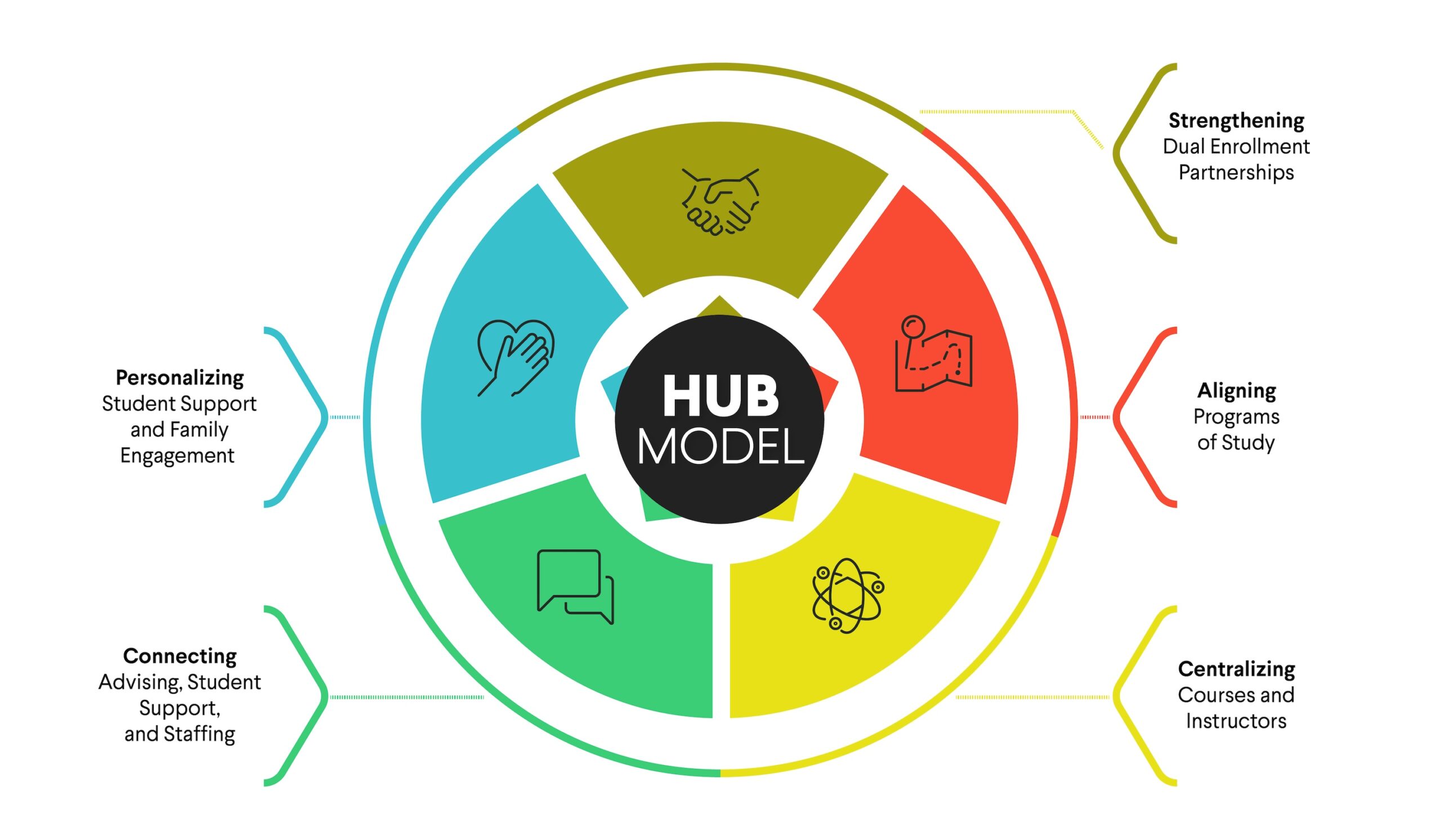
Circular diagram of the HUB Model showing five segments: Personalizing, Connecting, Strengthening, Aligning, and Centralizing, each with an icon and brief description.

Each IDEAS hub organizes dual enrollment by bringing together schools, colleges, and state systems under shared regional agreements. Hub responsibilities include:

  • Strengthening Dual Enrollment Partnerships: Create a consistent dual enrollment experience and minimize costs for all students through shared goals, vision, and partnership agreements between school districts and the college.
  • Aligning Programs of Study: Build a clear dual enrollment pathway to a postsecondary credential with at least 12 credit hours available.
  • Centralizing Courses and Instructors: Ensure students in all school districts can access 12 credit hours of dual enrollment coursework through a comprehensive instructional staffing plan with instructional modalities that maximize student access.
  • Connecting Advising, Student Support, and Staffing: Connect all students with a dedicated advisor at the high school or college level who supports success and completion through a shared advising plan between school districts and the college.
  • Personalizing Student Support and Family Engagement: Develop accessible, student-centered outreach and family engagement strategies that expand access to dual enrollment opportunities.

This structure creates consistency across institutions, making it easier to scale access and ensuring all students can graduate high school with meaningful college momentum.

During the first year partners found that success depends on three things: deep cross-departmental relationships between colleges and K-12 partners, merging recruitment with long-term engagement so DE students can actually use available supports, and building a shared vision between colleges and schools that makes credentialed high-school faculty and course offerings durable.

With additional colleges joining the second cohort, IDEAS is testing and refining the hub model across more regions. Early evidence shows that systems are ready to evolve, and the hub approach can help scale access to dual enrollment across the nation.

Cohort One

Blue geometric logo consisting of eight stylized, curved shapes forming a circular pattern, divided horizontally by a thin gray line.

Pima Community College (AZ)

A blue circular shape partially enclosed by a green, angular arrow pointing right with a black shadow on a white background.

College of Lake County (IL)

Blue stylized "AC" logo on a light gray background, with geometric shapes forming the letters.

Amarillo College (TX)

Blue interlocking letters "SJC" form a stylized monogram logo on a white background, with a small "SM" in the top right corner.

San Jacinto College (TX)

A navy blue abstract shape on a white background, resembling a shattered or fragmented object with irregular, sharp-edged pieces spreading outward.

Center for the Future of Arizona

A minimalist illustration of a light bulb with colored rays extending outward, representing ideas or creativity.

Education Systems Center at Northern Illinois University

Abstract logo featuring five overlapping, curved, and layered shapes in orange, yellow, gray, blue, green, and red on a white background.

Educate Texas

Get Started with Pathways to Prosperity

Learn how JFF’s Pathways to Prosperity network supports states and regions in building aligned, scalable pathways that connect education to quality careers.


A woman with glasses sits at a table in a library, looking at a laptop while holding an open book.
Jobs for the Future (JFF) transforms U.S. education and workforce systems to drive economic success for people, businesses, and communities.