How Fair Chance to Advance Works
Fair Chance to Advance supports states through coordinated strategies that bring together corrections agencies, education and training providers, workforce systems, employers, policymakers, and people with lived experience of incarceration. By aligning systems and using shared data, states can build clearer pathways from incarceration to quality jobs.
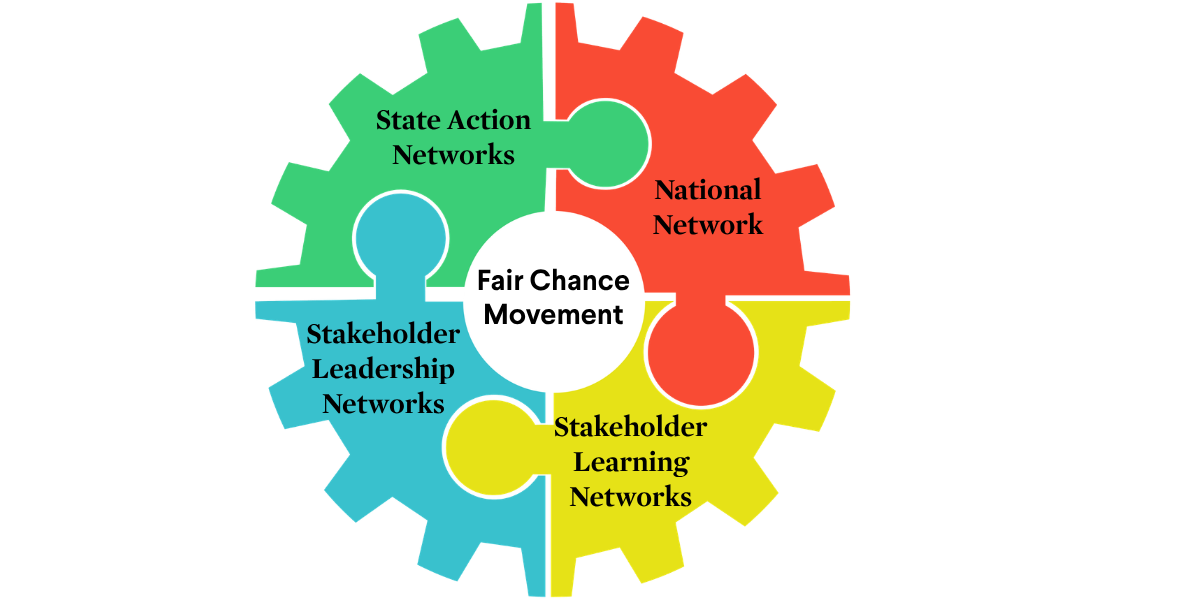
As illustrated in the graphic below, FC2A is comprised of four types of interconnected networks: state action networks, stakeholder leadership networks, stakeholder learning networks, and a national network.
State Action Networks
State Action Networks bring leaders together within individual states to speed up change in their state’s ecosystem. Through FC2A, these networks receive support to plan, coordinate, and track progress across education, workforce, corrections, and employment systems.
JFF works closely with states ready to move forward, helping them align leaders across sectors, set shared goals, and build the structure needed for long-term collaboration. JFF also supports states preparing to launch state action networks by helping them lay the foundation for future ecosystems change.
Stakeholder Leadership Networks
Stakeholder Leadership Networks offer professional development for emerging leaders in a variety of key fair-chance roles.
The FC2A Fellowship Program and the Corrections Education-to-Employment Leadership Academy are two examples of stakeholder leadership networks. They provide targeted learning experiences that help leaders build skills, advance professionally, and contribute more effectively to cross-system collaboration in their states.
Stakeholder Learning Networks
Stakeholder Learning Networks are open communities of practice made up of members of specific groups of stakeholders, including education providers, workforce leaders, or corrections professionals.
These networks—such as the Normalizing Education Collective—provide learning opportunities, shared resources, and technical assistance tailored to the unique roles these groups play in their states.
National Network
The FC2A National Network is open to representatives from any state who are committed to developing fair chance ecosystems. The National Network provides a space to elevate learning and best practices for developing collaborative state ecosystems, increase peer-to-peer support and knowledge sharing, and foster strategic connections.
State Action Networks
State Action Networks are cross-sector coalitions of leaders within a state who work collaboratively to quickly build statewide fair chance ecosystems by aligning and transforming siloed systems. Supporting State Action Networks is a core part of the Fair Chance to Advance initiative.
Through State Action Networks, JFF partners with state leaders to demonstrate what’s possible when education, workforce, corrections, and employment systems align around a shared goal: improving economic outcomes for people with histories of incarceration. FC2A state action networks receive funding, technical assistance, and support to build on work already underway and to track progress over time.
Inaugural State Action Network Cohort
With support from Ascendium Education Group, JFF is working with an inaugural group of four Fair Chance to Advance State Action Networks representing Kansas, Maine, North Carolina, and Oregon.

Each of these states will receive grant funding and hands-on technical assistance for up to four years to design and implement coordinated policies and practices that create clear pathways to education, training, and quality jobs for people who are or have been incarcerated.
What States Aim to Achieve
Throughout the four-year period, the State Action Networks will be working toward shared goals while also pursuing specific outcomes shaped by their states’ unique circumstances.
Examples of state-specific outcomes include:
- Expanding incarcerated learners’ access to high-quality postsecondary educational opportunities, including apprenticeships and other work-based learning experiences
- Stronger commitment from state policymakers to removing barriers and normalizing opportunity for people with records
- Increased employer adoption of fair chance hiring policies, with a focus on identifying and implementing best practices to ensure that these programs succeed
- Closer alignment between corrections education pathways and local labor market needs, to better ensure that the credentials people earn while incarcerated will lead to quality jobs
- An increase in the number of learners and workers who have access to the wraparound supports they need during reentry