Skip to content
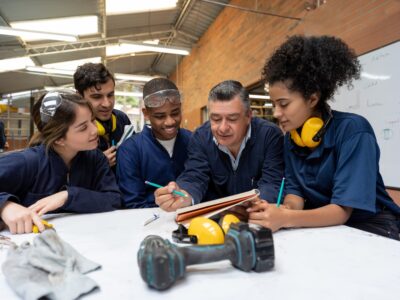
A group of students and an instructor in work uniforms gather around a table, looking at a notebook, with tools and safety gear visible in the foreground.
Post

From Vision to Action: The Next Phase of the Big Blur

Moving beyond concept to implementation—where educators and employers share responsibility for developing talent.

April 21, 2026

At a Glance

Big Blur 2.0 calls on employers to co-create talent development strategies in partnership with educators, moving from vision to action by fully integrating learning and work.

Contributors
Joel Vargas Vice President
Vinz Koller Vice President
Myriam Sullivan Associate Vice President
Anna O'Connor Senior Director
Jerre Maynor, Jr.   Senior Director   
Practices & Centers

In 2021, Jobs for the Future called for a radical redesign of our education systems and how they prepared young adults for careers. This vision, called  The Big Blur, decried the outdated divide between high school, postsecondary education and training, and workplaces that fail to engage and equip so many people between ages 16 and 20 with the skills, knowledge, and credentials needed for quality jobs. We imagined new systems of learning that:

  • Tailored education and training experiences to learners’ developmental needs and the needs of employers
  • Blurred the divides, blending the last two years of traditional high school with the first two years of postsecondary education
  • Integrated work-based learning experiences and culminated in credentials aligned to high-skilled, high-demand, quality jobs in local labor markets
A young man with headphones around his neck holds a laptop and wears a backpack, standing outside a modern glass building.

This vision was rooted in the principle of permeability—the idea that learners should be able to move fluidly between education and work as they develop their interests, capabilities, and career ambitions. Rather than forcing young people through rigid stages of preparation before they enter the workforce, education systems should enable them to build skills through a combination of classroom learning and real-world experience that evolves over time.

As audacious as the idea still is, five years later, it’s clear to us that it doesn’t go far enough. For one, some elements of our proposal appear more feasible than others. The concept of blurring secondary and postsecondary education found a complement in the dramatic growth of and interest in dual enrollment nationally—an increasingly commonplace practice often encouraged by state policy that K-12 and higher education institutions can use as a tool for bigger blurring. In contrast, the integration of work-based learning into the educational experience has no analogous systemic hooks and is stymied by a lack of widespread interest, investment, and capacity among employers to engage with educational institutions.

Today,  even starker challenges loom for learners, workers, employers, and the economy.  Advances in AI have considerably raised the stakes about the imperative of work-based learning. The seismic shifts in motion in the labor market will demand, first, blurring the lines between learning and working, but also an entirely new architecture for education systems that makes this the norm.

We call it Big Blur 2.0.

Woman in an orange blazer smiles and shakes hands with another person in an office setting, holding a folder under her arm.

AI is compressing the time between skill development and obsolescence. That reality fundamentally undermines the traditional  “learn first, work later” sequencing of education systems. Employers are increasingly demanding that job candidates have experience, even as AI disrupts the entry-level jobs that used to be ladders to quality jobs.

Big Blur 2.0 is a structural answer to these challenges. Here, learning and earning are intertwined precisely because adaptability, durable skills, and applied competence are becoming the real currency of opportunity.

The real work now is to move toward a new architecture in which integrated learning and work are the default, not the exception.

Placing work at the center of education—not the end

Over the past several decades, the default response to deep structural problems in education and career preparation has been to add more programs: college access initiatives, career academies, short-term credentials, mentoring schemes, and new grant-funded pilots. Each may do real good for a subset of students, but together they have produced a proliferation of disconnected initiatives layered on top of an architecture that has barely changed.

This program-centered approach fragments responsibility, forces students and families to navigate a maze of offerings, and makes it difficult to sustain and scale what works beyond the life of a grant. Educators and employers are asked to “partner” in one-off projects without a durable structure that makes collaboration part of how the system operates every day.

In a world being reshaped by AI and rapid labor-market change, this incrementalism is no longer tenable. The real work now is to move toward a new architecture in which integrated learning and work are the default, not the exception, and to stop trying to fix a 20th-century system with ever more 21st-century programs.

Two students with backpacks walk up outdoor stairs toward a modern brick school building.

This shift is not merely a matter of education systems figuring out how to engage more employers; education systems were never built with employers as co-architects of talent development. They were designed to produce graduates that employers would then hire. In that model, employer needs are theoretical requirements in curriculum meetings, not driving forces in system design. It’s a design flaw that has always been present, and the advent of AI has exposed it even more.

Nor is Big Blur 2.0 an incremental expansion of internships. It is a redesign in which employers share responsibility for skill formation from grade 11 onward.  Prevailing efforts to bridge education and employment position employers as peripheral supporters—internship providers, advisory board participants, and recipients of better-prepared graduates. This education-first approach assumes employer engagement will follow system change. It neither has nor will.

This shift also requires rethinking the architecture of education systems themselves. For too long, talent development in the United States has been organized as a pipeline, where learners progress through fixed stages before entering the workforce. Big Blur 2.0 envisions something closer to a lattice of opportunity, where learners can move in multiple directions—between work and learning, between credentials and experience—as they build skills and clarify their career goals.

Big Blur 2.0 starts with the premise that youth apprenticeship and other credit-bearing, paid pathways to quality jobs are central—not supplemental—to an education. Instead of asking employers to support education reform, we propose building a system where employers and educators co-design pathways from the start—making employers essential partners, not hopeful advisers.

As a country, we remain far from a culture in which employers and educators see themselves as co-owners of a shared system for talent development. Big Blur 2.0 is about finishing that shift.

The business case for Big Blur 2.0

The business case for Big Blur 2.0 has been clear for some time. What is different now is that it is fast becoming conventional wisdom that we must replace the old model, where young people front-load education and hope it pays off later, with an approach that intentionally integrates paid, applied experience with formal learning from the start. In an AI-driven labor market, employers that invest early and systematically in talent formation gain a decisive adaptability advantage. When learning and work are intentionally integrated from the later years of high school through the first years of postsecondary education, employers don’t just assist with education—they build the capabilities they themselves need to compete and grow.

Smiling woman with curly hair and hoop earrings shakes hands with another person indoors, standing near a window.

Return on investment shows up in multiple ways: lower turnover, faster time-to-productivity, and deeper internal pipelines for advancement. For example, apprenticeship programs routinely see retention rates around 90%, compared with typical rates of 60–70% in many sectors—a difference that can easily translate into hundreds of thousands of dollars in avoided turnover costs each year for a mid-sized employer. And with apprenticeships in place, they are also building workforce capability along the way.

There are encouraging signs that leading employers are already moving in this direction, recognizing that working and learning now need to go hand in hand and that they must share responsibility with educators for developing—and attracting—the next generation of talent. Yet as a country, we remain far from a culture in which employers and educators see themselves as co-owners of a shared system for talent development. Big Blur 2.0 is about finishing that shift: replacing a “learn first, work later” pipeline with a lattice of opportunity in which applied learning, durable skills, and validated workplace experience are the core of how young people prepare for careers.

A call to action

To realize this vision, we need a bolder, system-level call to action—one that sets clear goals and organizes state, regional, and local efforts around them. Over the next decade, at least 50% of young people should have access to high-quality, paid, credit-bearing work-based learning experiences connected to pathways into quality jobs.

That goal should not be limited to a few innovative regions or sectors; it should become a baseline expectation for how our education and workforce systems serve 16-to-24-year-olds. It should be a responsibility of any and all systems and stakeholders serving these young adults, be they high schools, community colleges, four-year colleges, community based organizations, or employers. Ideally, if not requisitely, these actors will partner to make achieving this goal a joint responsibility.

Getting there will require redesigning systems, not just expanding isolated programs. Big Blur 2.0 points to several key design priorities:

Two young women, one wearing a hijab, walk indoors holding papers and talking. Other people with books and laptops are visible in the background.
  • Make employers co-architects of pathways, not peripheral partners. From grade 11 onward, employers should share responsibility with educators for defining competencies, shaping curricula, and providing real work-based learning at scale—so talent development is built with them, not merely for them.
  • Scale practical entry-point models that blend learning and work. These are programs—like youth apprenticeships, work-based courses that embed job experience into credit-bearing instruction, intentional “first jobs” that build transferable skills, and employer-connected and designed projects—that give young people early, supported exposure to real work while earning credit and credentials, and that act as on-ramps to a broader ecosystem where work is a primary site of validated learning.
  • Build enabling infrastructure for a skills-based system. Tools such as digital learning and employment records, and skills passports can make learning—wherever it happens—visible and portable, helping young people carry their experiences across institutions, employers, and regions as they advance.
  • Align policy and funding with integrated pathways. State and federal policies, accountability systems, and funding streams should reward institutions and regions that make work-based learning central to the secondary–postsecondary experience, especially for students who have been least well-served by the current system.

The conditions for transformation exist now: education systems need employer partnerships for competitive survival, employers need reliable talent pipelines, and young people need pathways that connect learning to earning in ways that can keep up with AI-driven change. Big Blur 2.0 offers a framework for designing that shared system—one in which employers, educators, and learners all benefit from a new architecture that fully integrates learning and work.

Learn more about our work with The Big Blur

Get started with Pathways to Prosperity

Learn how JFF’s Pathways to Prosperity network supports states and regions in building aligned, scalable pathways that connect education to quality careers.

See how our Center for Apprenticeship and Work-Based Learning is expanding access to career-connected learning.

Jobs for the Future (JFF) transforms U.S. education and workforce systems to drive economic success for people, businesses, and communities.