
Get Started With Pathways to Prosperity
Learn how JFF’s Pathways to Prosperity Network supports state and regional leaders in building education-to-career systems that work—for learners, employers, and communities.

October 9, 2025
JFF helps drive regional and statewide pathways systems infrastructure, implementation, and innovation in Texas.
The Texas Regional Pathways Network (TRPN) brings together state and regional leaders to build strong educational and career pathways that prepare Texans for careers in high-wage, in-demand industries.
Launched in 2019, the TRPN is a signature initiative of the Tri-Agency Workforce Initiative, through which the Texas Education Agency, Texas Higher Education Coordinating Board, and Texas Workforce Commission are working collaboratively to increase economic prosperity by linking education and industry. Pathways leaders engaged in the TRPN represent multiple sectors, including secondary and postsecondary education, workforce development, business and industry, local government, and nonprofit organizations.
Since its launch, Jobs for the Future (JFF) has been a lead partner to the TRPN, shaping the network’s design and strategy and helping more than 30 regional intermediaries—such as workforce boards, education service centers, community colleges, and nonprofits—strengthen their partnerships, map local assets, leverage data effectively, plan for sustainability, expand work-based learning, and communicate impact. Through coaching, webinars, and meetings, JFF equipped regional leaders with the tools and strategies they need to turn the TRPN’s vision into action.
Texas has one of the most advanced and rapidly evolving college and career pathways landscapes in the country. Pathways stakeholders are navigating multiple models and partnership structures—such as early college high schools, P-TECH, dual credit, career and technical education (CTE) programs, and Rural Pathway Excellence Partnership Programs (R-PEPs)—each with distinct design features, expectations, and outcomes. At the same time, labor market needs vary significantly across regions, requiring pathways to adapt to different industries and workforce demands. Layered on top of this complexity is a shifting postsecondary policy environment in the state, with changes in funding formulas, dual credit guidance, and transfer and credentialing requirements. Together, these factors create a complex landscape that challenges educators, employers, and policymakers to advance high-impact strategies and coordinate efforts so that pathways truly lead to quality careers and credentials of value.
The TRPN is designed to solve problems that individual partners and regions cannot address alone. Without a statewide framework, regional partnerships risk inconsistent quality, limited alignment with state policy, and duplication of efforts. Some regions may lack the funding or technical capacity to sustain pathways work, while others face data gaps that make it difficult to compare progress across the state. A statewide network like TRPN provides the connective tissue: it establishes shared standards and supports, reduces duplication, builds regional capacity, ensures access to resources, and surfaces and scales innovations that might otherwise remain isolated.
The TRPN is grounded in a statewide framework for high-quality pathways implementation, customized for the Texas context by leveraging foundational concepts in JFF’s Pathways to Prosperity framework.
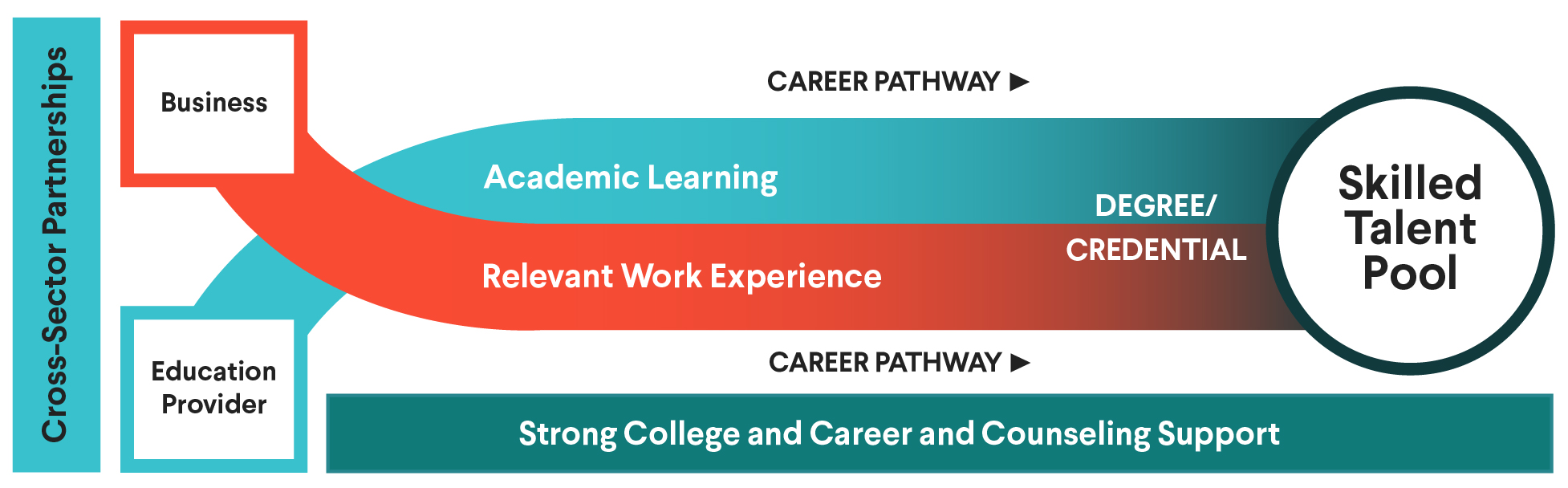
The TRPN drives pathways infrastructure, implementation, and innovation through two complementary initiatives:
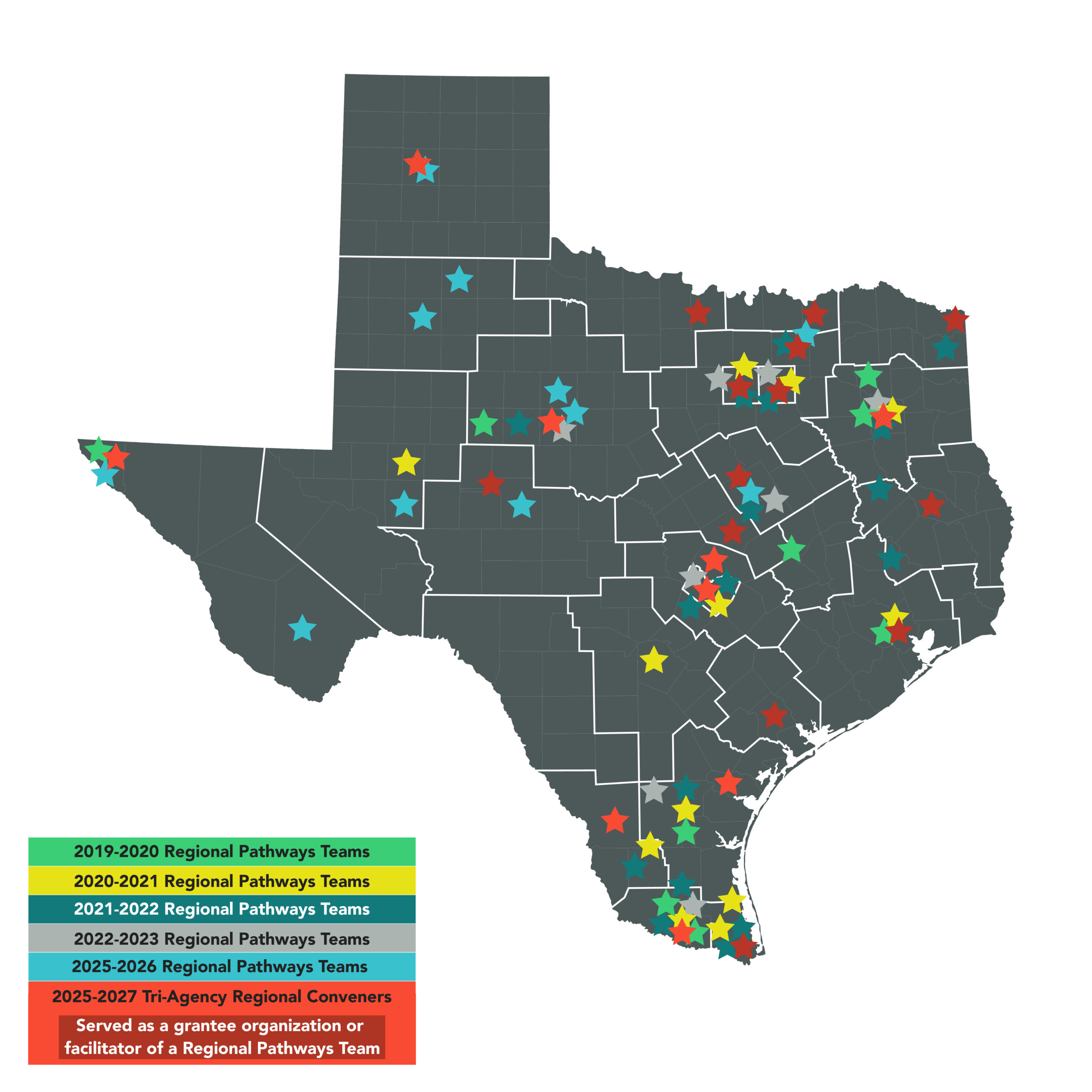
The intentional design of the network helps break down traditional silos between secondary and postsecondary education and workforce partners by regularly bringing together cross-sector teams within regions and designing and monitoring mutually agreed-upon strategic plans and goals. The common language and alignment around goals also help network members pursue other state and national funding opportunities to sustain and scale high-quality pathways. This has been especially impactful for rural communities, bringing new resources into areas of the state with unique challenges to advancing pathways for all students.
The network has reached more than 120 local education agencies, more than 35 institutions of higher education, 24 workforce boards, and more than 100 employers across the state. In all, 98 grants have been awarded since the launch of the network, expanding pathways into more than 20 in-demand industries across the state.


“[We’ve] moved past transactional relationships with cross-sector partners to deeper partnership. Partners are now proactively reaching out to us to discuss opportunities and strategies.”
— Network Member
“This was an opportunity to really see the gaps and needs in the region. Digging deeper uncovered gaps we weren’t aware of and allowed us to put stronger pathways strategies in place.”
— Network Member
“[This network] was instrumental in helping us obtain our work-based learning goals. During the past year, we learned so much about what makes quality work-based learning opportunities for students.”
— Network Member

Learn more about the history of the TRPN and how regional intermediaries are advancing pathways infrastructure across Texas.
Learn how JFF’s Pathways to Prosperity Network supports state and regional leaders in building education-to-career systems that work—for learners, employers, and communities.

With over a decade of leadership in the pathways movement, we bring incomparable expertise, collaboration, and a relentless curiosity to our partnerships with state and regional leaders.

This resource clarifies the roles intermediaries play in college and career pathways systems. It can be useful for envisioning a brand-new organization or strengthening the intermediary functions of an existing organization. Your organization can use this guide during a strategic planning process or at any time to reflect on its practices, shift its focus, or reconnect to its mission.