Skip to content
Young man sitting at a table with a laptop, holding a pencil, and studying an open book in a bright, modern setting.
Tool

Integrating Social-Emotional Learning for Online Dual Enrollment Success

A road map for designing and implementing course innovation

March 16, 2026

At a Glance

Online dual enrollment courses that integrate social-emotional learning enable high school students to access, authentically engage with, and succeed in early college coursework. This guide offers a road map for postsecondary institutions to design and scale these courses through:

  • High-quality professional development for instructors
  • Coordinating student access and support
  • Engagement with high school partners
Contributors
Anna O'Connor Senior Director
Practices & Centers

A woman sits at a table, smiling while writing in a notebook and using a laptop in a bright, modern indoor space.Dual enrollment, which allows high school students to earn college credits before they graduate, remains a powerful strategy for expanding college and career opportunities and offers wide-ranging benefits (PDF) for students, high schools, colleges, and states. When dual enrollment courses are offered online, they further expand access and opportunity. The digital format, however, makes it harder to provide the supportive, collaborative environment that boosts student engagement, learning, and success.

Jobs for the Future (JFF) launched the Increasing College Access Network (ICAN) project in 2022 to address this challenge by integrating social-emotional learning (SEL) strategies into online dual enrollment courses to improve students’ course outcomes.

Over three academic years, in partnership with two Minnesota community colleges and 58 high schools, more than 900 students participated in this course model. By embedding a series of routines and structures that emphasize student relationship-building and resilience, the model yielded benefits for students, instructors, and secondary and  postsecondary institutions.

Key Benefits for Stakeholders

Students

  • Develop a college-going identity
  • Learn how to build and leverage relationships with other students and instructors for support
  • Practice and build college and career readiness skills
  • Persist through course challenges to earn college credit early

School Districts

  • Improves course outcomes that contribute to district goals and accountability
  • Expands quality dual enrollment offerings to meet student needs
  • Provides an additional layer of course support for students

Instructors

  • Positively influence student success within the course
  • Access tested, ready-made tools and strategies to blend into course design
  • Quickly identify student challenges early to intervene

Colleges

  • Builds instructor confidence and job satisfaction
  • Easily accessible strategies that can be scaled across the college
  • Potentially contributes to student matriculation

Supported by FullScale, the Greater Twin Cities United Way, and the American Institutes for Research and with funding from the U.S. Department of Education, college instructors piloted the model in both online dual enrollment English and math courses. Instructors from both colleges found innovative ways to adjust the strategies for synchronous and asynchronous course delivery, student needs, and hurdles along the way.

What is this model?

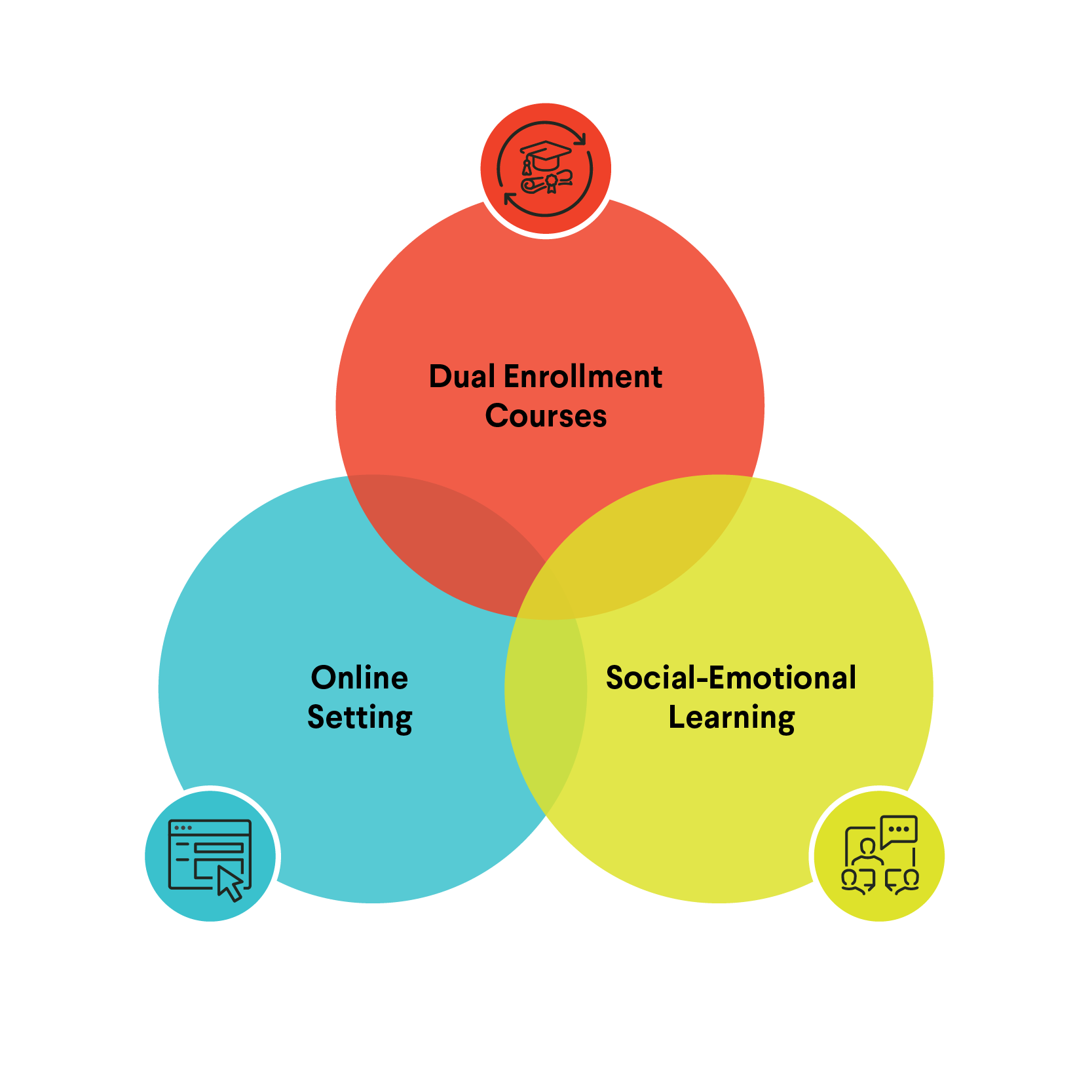
These online dual enrollment courses incorporate social-emotional learning into the course curriculum to amplify authentic learning. By implementing SEL in the context of online dual enrollment, students are better able to build the skills needed for perseverance and success in online course-taking and build meaningful connections with peers and instructors, supporting the development of a strong academic and collegiate identity.

A Venn diagram with three circles labeled Dual Enrollment Courses, Online Setting, and Social-Emotional Learning, showing their overlap and related icons.

Why Invest in Integrating SEL Into Online Dual Enrollment?

One-third of all dual enrollment courses are now delivered online. They enable high school students, especially those from rural areas, to earn college credit, experience rigorous coursework, and begin to see themselves as a college student before stepping onto a college campus. This model provides unprecedented access and flexibility not just for learners but also for institutions looking to expand high-quality offerings to new groups of students.

Two students sit at desks in a classroom, working together on a laptop with notebooks and papers spread out in front of them.

“Students are coming back and saying, what other courses is [my instructor] teaching next semester?”

-Kile Behrends, Director of K-12 Partnerships, Minnesota West Community and Technical College

However, delivering dual enrollment courses online presents specific challenges:

  • Students must juggle navigating new expectations and processes, limited face-to-face interaction, and the demand for self-management without the scaffolds and support they rely on in high school.
  • College faculty are called on to deliver content in new ways to keep students engaged, yet their training does not typically focus on pedagogy, leaving gaps in quality student engagement methods that are especially important for online delivery.

Embedding SEL strategies into online coursework helps address these challenges:

  • SEL supports students by helping them develop self-directedness, a critical driver of success in virtual settings. This includes self-awareness to recognize when they may be struggling, a variety of problem-solving strategies, and the ability to advocate for extra help if needed.
  • SEL strategies also help surface challenges early, so an instructor can intervene and provide additional support.
  • Students develop durable skills, such as relationship-building and problem-solving, that are increasingly critical to young people’s success in the labor market and their ability to launch meaningful careers.

Research Finding

Students feel connected to and supported by instructors: Preliminary findings from the ICAN project suggest that students in sections with embedded SEL strategies reported significantly higher levels of perceived instructional support and instructor caring than students in sections taught by the same instructor without these strategies.

The model provides instructors with guidance and tools to effectively integrate these strategies in ways that align with their course objectives and subject area. Integrating SEL doesn’t require new lessons or a rewritten syllabus; they’re simple routines that can accelerate instructional effectiveness and student success in an online college environment.

“[Our program] struggled with math enrollment, often having to cancel sections due to low enrollment. Spring semester is now on a waitlist. [This model] helped our high school partners see students could be successful in an online math course.”

-Mary Lenz, Manager, Online College in the High School, a collaborative program between Alexandria Technical & Community College, Northland Community & Technical College, and Northwest Technical College

Implementing the Model

Course instructors embed a set of activities, routines, and structures that provide opportunities for students to develop, practice, and refine relationship-building, problem-solving, growth mindset, and self-management skills. Instructors build the following SEL strategies into their course and repeat and blend the strategies in ways that fit their course design and sequencing:

Emotions Check-In

Helps students pause, notice, and name what they’re feeling as they approach and engage in learning—a critical step in understanding how to self-regulate during challenging moments.

Challenge of the Week

Surfaces common challenges that students face in collegiate courses and prompts students to reflect and problem-solve to overcome them.

Calendar Look-Ahead

Encourages planning and time management by helping students prioritize upcoming tasks and balance commitments.

Self-Assessments

Builds metacognition through self-ratings on course progress, goal-setting, and confidence checks.

Team building

Encourages connection and community through structured peer interaction and provides opportunities to practice communication and listening skills.

Individual Check-Ins

A personalized connection between a student and an instructor that fosters meaningful communication about course progress.

Instructors leverage resources and receive support to integrate these strategies into their courses and continuously improve their instructional strategies. Alongside this, colleges and high school partners coordinate critical activities to support student access and success, particularly in an online course delivery format.

Next Steps in Implementing the Model

Getting Started

Monitoring & Measurement

Lessons & Considerations

Get started with Pathways to Prosperity

Learn how JFF’s Pathways to Prosperity network supports states and regions in building aligned, scalable pathways that connect education to quality careers.

Jobs for the Future (JFF) transforms U.S. education and workforce systems to drive economic success for people, businesses, and communities.