Skip to content
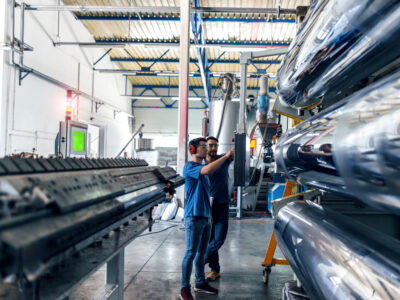
Two workers wearing safety gear inspect large rolls of plastic film in an industrial manufacturing facility.
Impact Story

High School-Employer Partnership Brings the Earn-and-Learn Model to School

October 23, 2025

At a Glance

Tennessee’s Fayetteville High School partnered with a local manufacturing employer, AriensCo, to create an on-site welding lab as part of a dual enrollment work-based course. An instructor from the Tennessee College of Applied Technology teaches welding and students gain workplace skills and college credit in the lab.

In Tennessee, a group of high schools, colleges, and employers tested the dual enrollment work-based course (DE-WBC) model throughout the state on over 600 high school students. These courses, supported by JFF in collaboration with the Tennessee Department of Education and with funding from the U.S. Department of Education, enabled high school students to simultaneously experience college-level courses, gain college credit, and practice workplace skills.

Fayetteville High School partnered with a local manufacturing employer, AriensCo, to create an on-site welding lab. Located on the plant floor, the lab features a fully enclosed learning space with a classroom and safe welding trainers and serves high school students from multiple school districts in the region. A welding instructor from TCAT Shelbyville teaches dual enrollment courses in the lab, allowing students to earn college credit toward TCAT’s Welding Technology program 

How was the welding lab designed with AriensCo and other partners? How did you get buy-in?

A person with short, gray hair and light skin is sitting indoors, looking at the camera and smiling slightly.Rujena Dotson, CTE Director for Fayetteville City Schools: Fayetteville City Schools is a very small school system, so we need to get creative with how we offer programs and experiences like this to our students. As we’ve reviewed labor market data over the years, welding continues to pop up as a high-skill, high-wage occupation, and there is significant industry demand in the area. It was a no-brainer to offer a welding program to our students, but we lacked the space at the high school for all the necessary equipment, and we did not have a qualified instructor.

When the AriensCo manufacturing plant opened up in Fayetteville, it bordered our campus, and there were welders on staff at the plant. This seemed like the perfect employer partner for a welding program, and it’s a large plant with plenty of space. I connected with the plant manager through existing contacts in the community, and he expressed interest in partnering to offer this welding program. We then brought Fayetteville-Lincoln County Industrial Development Board and the Fayetteville Lincoln County Chamber of Commerce to the table to design the space and to figure out what equipment needed to be in it. It was a community dialogue that really made it all come together.

AriensCo took out some loans to start up the plant in Fayetteville, and a loan requirement was to document how the plant was making positive contributions to the local community. So they were already looking for an opportunity to meet this requirement. When I approached the plant manager about the welding lab idea, he was mostly excited about it because of the possibility of having a local stream of potential employees right there in the plant, but it also allowed them to meet the requirements of those loans. Both of these were incentives for the employer to get involved and really helped with buy-in.
How did you go about funding the welding lab?

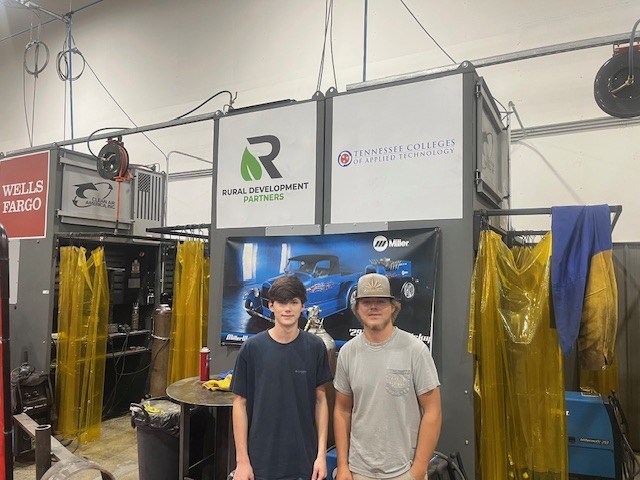
Two young men stand in front of welding booths with signage for Rural Development Partners and Tennessee Colleges of Applied Technology. Workshop equipment and safety curtains are visible.When Innovative School Models (ISM) funding became available to all high schools in Tennessee, we had the goal to utilize those funds to make the greatest long-term impact. We wanted to serve more students through dual enrollment, and we knew that welding was an industry need and opportunity in the area. To get the lab fully up and running at the plant, we needed to purchase enough welding equipment so that the TCAT could run a full program in the space. The amount of funding available through ISM enabled us to purchase all necessary equipment for the space. Once the facility and equipment were in place for the program, there was built-in longevity and sustainability since we were able to cover most of the startup costs with ISM funding.

We knew that another barrier our students would face is the high cost of required materials and protective gear for the welding program. We used the Tennessee SySTEM grant to cover these out-of-pocket expenses. This grant also helped us to fund a portion of the TCAT welding instructor’s salary so that he could travel to AriensCo to teach dual enrollment students onsite in the welding lab.

The welding lab is available to students at Fayetteville High School and to students at other high schools. What was the process for creating a regional model around this lab?

I may never have more than 3-4 students that would enroll in a welding program, so I was never going to be able to create it and then sustain it on my own. Other small school districts in the area had the same barriers to establishing their own welding programs – they didn’t have the appropriate space or an adequate number of students to fill the seats for a TCAT program. But Lincoln County High School, Franklin County Schools, and Moore County High School each had a handful of students who wanted to access the program too. By joining forces and opening access to students at all of our high schools, it made it beneficial to more students and families and to the TCAT because of the additional program enrollments made possible through our district partnerships.

What is your long-term vision for the welding lab?

Another element of our ISM grant that we’re excited about long-term is career exploration activities at Fayetteville Middle School starting in 7th grade. This is in every career cluster available to them at Fayetteville High School, so they start to get a taste of what they might like to do for work as an adult. One Fayetteville student who never did well academically and was known to have discipline problems for several years discovered welding toward the end of high school and really fell in love with it—welding was a skill that really came naturally to him. Now he views school as something positive that he cares about, but what if we could have found that for him during his freshman year, or even in middle school? That’s the sort of culture we’re trying to create in our school system, where every student has the opportunity to start learning about jobs they might enjoy, and which CTE programs can help them start that journey.

What advice would you give to other schools who are interested in implementing this course model?

One size does not fit all. When you have an idea and you try to implement it, things will inevitably go differently than you planned. You will encounter barriers and bumps in the road, but we kept the end in mind and stayed the course. The process didn’t end up playing out the way we thought it would, but if you’re committed to keeping it evolving, there’s tremendous benefit to students and the broader community. Every school and every community is different and unique. Just continue to tweak it and evolve it to fit your needs, the community’s needs, and the students’ needs.

Learn more about dual enrollment work-based courses

Dual enrollment work-based courses allow high school students to gain college credit and practice workplace skills at the same time. This step-by-step model offers: guidance for high schools, colleges, and employers and case studies from across Tennessee.