Expanding Opportunity for IMGs
A former physician working as a rideshare driver. A neurologist working as a barista. These are the realities many international medical graduates (IMGs) face after completing their medical education and training abroad, only to encounter steep barriers to rebuilding their careers in the United States. Their experiences reflect a broader workforce challenge: employers and systems too often lack effective ways to recognize and evaluate talent that falls outside traditional pathways, leaving many skilled workers unemployed or underemployed, even as industries face pressing labor shortages. In health care, that disconnect is especially pronounced. At a time when the United States is experiencing significant shortages of health care practitioners (according to the Association of American Medical Colleges, the United States could face a shortage of up to 86,000 physicians by 2036), internationally trained physicians remain sidelined by barriers to relicensure and reentry.
Those national shortages are playing out acutely in Washington, where physician shortages are especially severe in primary care and rural communities. According to a report to the Washington State Legislature, more than half of the state’s residents live in a primary care shortage area. The International Medical Graduates Academy (TIMGA), a Washington-based nonprofit, has taken notice of the many IMG professionals who remain underutilized, even as communities struggle to access care. The organization has worked to bridge the gap by helping IMGs navigate relicensure pathways, connect with employers, and return to patient care. The results are significant: 90% of physicians supported through TIMGA are working in rural communities and have served roughly 70,000 patients, as reported by an internal organizational survey.
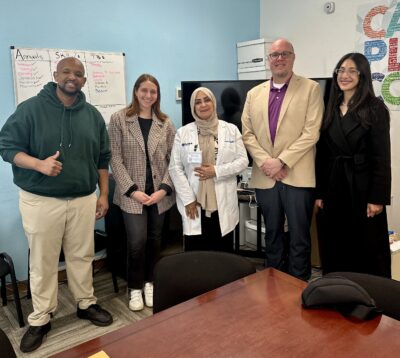
TIMGA is a part of the Rural Immigrant Success Exchange (RISE) convened by Jobs for the Future (JFF), with support from the WES Mariam Assefa Fund and Ascendium Education. It offers a compelling example of how immigrant-led organizations can promote both economic advancement for people and industry-wide solutions to health care talent shortages while illustrating a broader need for employers to adopt better, more skills-focused ways to identify talent. JFF met TIMGA participants and visited two health care clinics in Washington this past spring. One physician was from the Congo; the other was from Sudan and had spent more than a decade trying to relicense while working in medical interpretation and continuing to study. During the clinic visits, both doctors praised TIMGA’s customized support and employer connections as critical to helping them reach their goal.
From Lived Experience to Collective Action
As an IMG himself, Mohamed Khalif understood firsthand the barriers facing foreign-trained health care workers. He sought to better understand the recredentialing system, which is the process that foreign-trained professionals must go through to obtain a license to practice medicine in the United States. At the suggestion of a local community leader, he created an informal WhatsApp group in 2016 to connect with other IMGs. It began with a handful of people, who then added friends, former colleagues, and acquaintances. Within a month, the group had grown to 100 physicians hoping to return to medical practice in the United States. With that, Khalif founded TIMGA.
The mission was to address and break down the barriers preventing IMGs from achieving their professional and medical career goals. These include navigating a complex licensing process, studying for exams while working and caring for families, applying to U.S. residencies, and securing employment. This requires significant time and financial resources after already completing the necessary training and credentials in their home countries. Originally called the Washington Academy for IMGs, the organization provided career counseling, mentorship, and employment services for IMGs in Washington state. As the program grew, the organization expanded into rural communities through the RISE network. It scaled its national reach by partnering with field providers serving IMGs in other states through a train-the-trainer model and sharing lessons learned.
While TIMGA provided much-needed direct services, Khalif knew legislative change was needed for greater impact. He created relationships with policymakers, complementing TIMGA’s core program with statewide policy and advocacy efforts.
Policy and Advocacy
Building an Alternative Pathway
In March 2026, the state of Washington signed Senate Bill 5185 into law, establishing an alternative pathway for IMGs to practice medicine in the state without having to repeat the full U.S. residency system. This effort had been relentlessly championed for over 10 years by TIMGA and the Washington Medical Commission, the primary architects of the legislation. Their strong partnership enabled the long-term advocacy and education needed to build understanding, buy-in, and support among legislative staff and policymakers.
Senate Bill 5185 creates a supervised clinical experience license in which qualified IMGs can work under board-certified physicians, gain hands-on experience, and eventually qualify for a full and unrestricted Washington medical license after four years of supervised work experience. It was designed to help address statewide physician shortages, especially in primary care and areas with limited access to physicians, by allowing experienced IMGs living in Washington to return to practice more quickly and builds on the initial success of SHB 1129, which created the first limited license pathway for IMGs in 2021. Importantly, the bill also reduces administrative burden for IMGs by easing paperwork and licensing barriers, including for applicants who have difficulty obtaining documents due to war or displacement.
The success of Senate Bill 5185 has positioned Washington as a national model for similar efforts across the country. As of June 2026, over 15 states have adopted or begun the process of adopting similar legislation, opening pathways for IMGs nationwide to return to their careers and serve their communities. Washington’s new pathway is a critical milestone, but TIMGA has found that policy change must be followed by employer awareness and hands-on implementation support to become a true workforce solution.