Skip to content
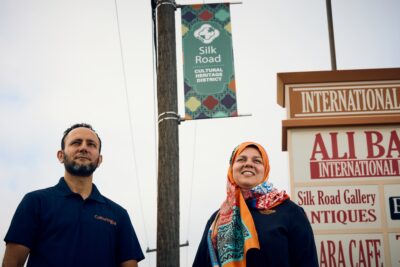
Two people stand near a street sign for the Silk Road Cultural Heritage District and a sign for Ali Baba International Market.
Case Study

Culturingua Builds Opportunity in San Antonio

At a Glance

In San Antonio’s Silk Road District, Culturingua pairs immigrant entrepreneurship, cultural placemaking, and public-sector partnership to expand belonging, business growth, and long-term community wealth. 

Contributors

On a weekday afternoon in February, Ali Baba International Food Market in Northwest San Antonio was abuzz with shoppers stocking up on Ramadan staples like dates and lentils, while others ran in quickly for freshly baked pita bread or South Asian noodles. With all the enticing attractions, it would have been relatively easy to miss the small plaque at the front door noting the market and surrounding plaza’s historic role as a “center for other culinary destinations and shops with the goal of bringing various cultures together.” 

When visiting the neighborhood with Culturingua co-founders Nadia Mavrakis and Nader Mehdawi, the significance of this and other historical plaques marking cornerstones of the city’s Silk Road District is illuminated. Culturingua was one of the leading champions that promoted the city’s official designation of this community as San Antonio’s fourth Cultural Heritage District in late 2024. Mavrakis describes the designation as generating a “tremendous sense of pride and unity” among the region’s Filipino, Chinese, Indian, Iranian, Arab, and African communities, who now see themselves as part of a shared story. 

Part of the Rural Immigrant Success Exchange (RISE) network, convened by Jobs for the Future (JFF), with support from the WES Mariam Assefa Fund and Ascendium Education, Culturingua conducts entrepreneurship training to help community members launch and scale small businesses, often drawing on the expertise they bring from their home countries. For its RISE initiative, Culturingua developed a training pathway in the animal husbandry industry in the rural outskirts of San Antonio, serving primarily Afghan participants from agrarian communities. Culturingua exemplifies the community-based work of building strong regional economies—work that is central to JFF’s commitment to breaking down barriers to economic advancement and reimagining what’s possible.  
The Power of Place

San Antonio has long had a strong Middle Eastern community and has played a leading role in refugee resettlement, receiving over 3,800 Afghan refugees after the withdrawal of U.S. troops in August 2021. While refugees and immigrants have long found community in the Northwest part of the city, new arrivals still face challenges in realizing long-term economic advancement. At the local level, newcomers are disproportionately represented in the area’s public housing and apartment complexes with substandard conditions.  

Culturingua addresses these challenges and promotes collective investment in the Silk Road Cultural Heritage District through a multi-pronged approach, developing solutions at the intersection of people, place, and economic opportunity. Key areas of focus include: 

Small business development

Culturingua supports aspiring entrepreneurs through cohort-based training, professional network building, and access to culturally responsive capital. Its programs are intentionally asset-based, helping participants translate existing skills—such as cooking, sewing, and animal husbandry—into viable business pathways. In partnership with Local Initiatives Support Corporation (LISC) San Antonio, Culturingua has also connected entrepreneurs to zero-interest Kiva loans, an especially important option for participants seeking financing aligned with personal values that prohibit interest. As winners of a citywide “Philanthropitch competition in 2021, Culturingua received funding to launch Nourish to Flourish, the city’s first mobile commercial kitchen accelerator.

History, arts, and culture

Culturingua’s arts and culture work has helped transform the Silk Road District from a loosely recognized immigrant corridor into a more visible and celebrated community geography. Events like the annual Silk Road Festival reinforce that shared sense of connection and belonging in this distinct geography—which is particularly powerful for groups that have experienced displacement and migration—while drawing broader public attention to the district’s cultural and economic assets.

Community land trusts

Keenly aware that neighborhood improvement and investment in arts and culture can lead to gentrification, Culturingua has recently taken the lead in leveraging a community land stewardship model to address the housing barriers its community faces. A community land trust (CLT) is a nonprofit model that lowers home purchase prices by separating home ownership from land ownership. Culturingua led a two-year community engagement process that recently resulted in the February 2026 approval of the Silk Road Community Land Trust, one of the first two CLTs authorized in San Antonio.  In April, the city council approved $1.5 million for the project, allowing the CLT to acquire and rehabilitate an initial 10 homes.

Building a Bridge to City Hall 

A defining feature of Culturingua’s impact is its ability to bridge newcomer communities and local government, translating trusted community relationships into durable public-sector partnerships. Culturingua’s leaders have consistently shown up at City Hall meetings to elevate the significant contributions of their community and advocate for their interests; in return, the city has repeatedly reached out to ask Culturingua to lead initiatives such as multilingual Census outreach and an integration initiative for newly arrived Afghans called Community of Welcome. In 2021, a signature event for this program, the San Antonio Welcome Walk, featured influential speakers, including then-Mayor Ron Nirenberg. As the organization’s profile grew, it established important connections with city council members who eventually championed the Silk Road Cultural Heritage District designation. Leaders Mavrakis and Mehdawi seized each opportunity to build introductions to elected officials and followed up diligently to explore mutually beneficial partnerships with the long game in mind. 

Culturingua’s savviness in navigating government processes and identifying potential opportunities has brought wins large and small for the organization and community members alike. Within the Silk Road District, the organization has helped small business owners access funding for storefront improvements and noise mitigation, for example, providing the resources restaurants need to update their facilities and attract new customers.  

Leadership Profile

Strategic Adaptation and Resilience in the Face of Change

Co‑founders Nadia Mavrakis and Nader Mehdawi have led Culturingua through a series of intentional shifts—from its founding as a small language and culture nonprofit in 2018 to its role today as a community and economic development organization. Both transitioned into nonprofit leadership after working in Fortune 500 corporations. From the beginning, they have treated Culturingua as a living strategy that must evolve alongside the community and its context. 

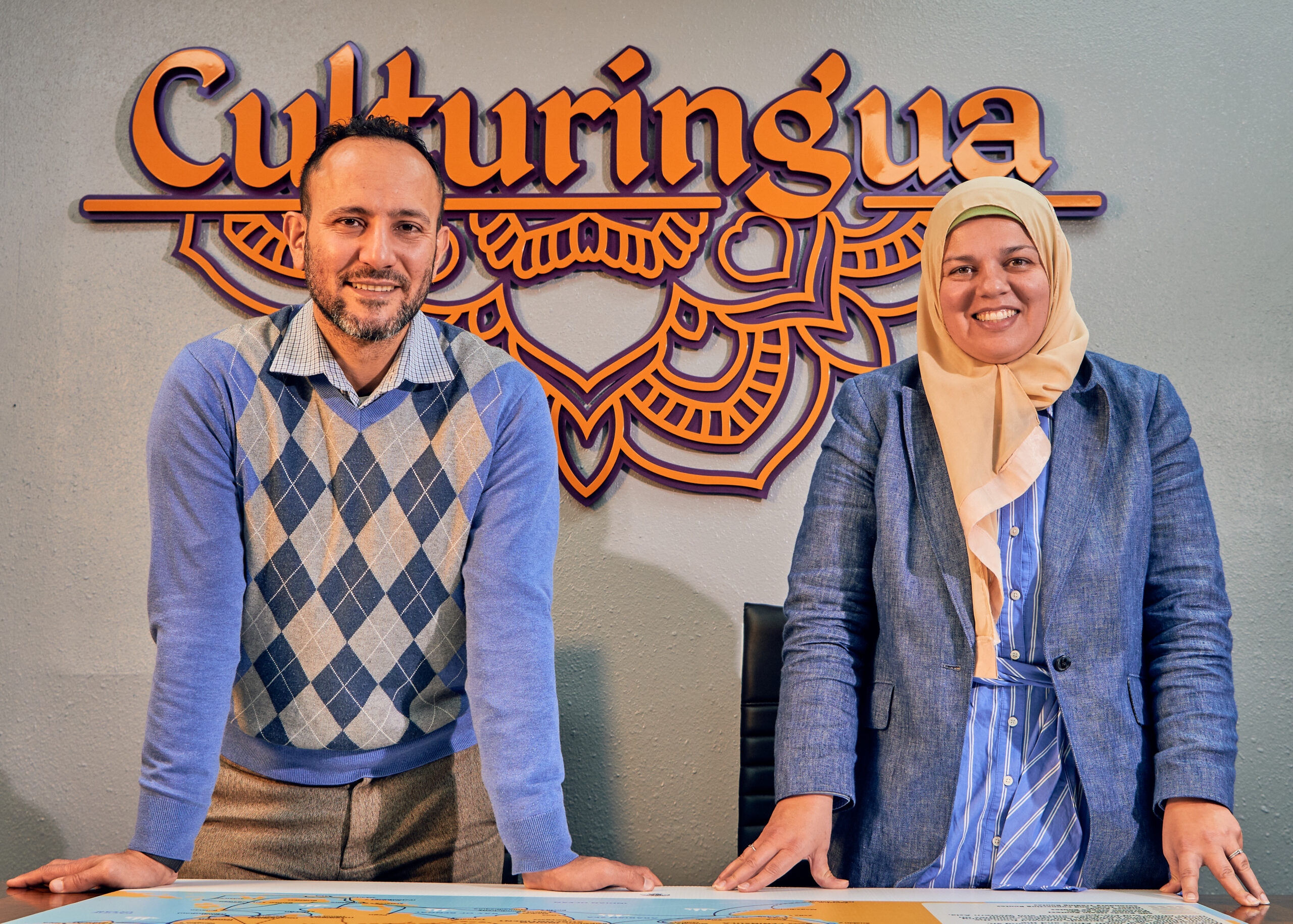
Two people stand side by side at a desk with a map, in front of a wall sign that reads
  • Strategic Evolution: Culturingua’s evolution has been driven by its leaders’  willingness to refine their focus to meet community needs. The COVID-19 pandemic was a forcing event that spurred greater focus on economic development. In response, they revisited their strategic plan, clarified their value proposition, and doubled down on an asset‑based model that starts with participants’ existing skills and networks.  
  • Intentional Framing: Mavrakis and Mehdawi have recognized the benefits of adopting inclusive, place-based framing for their work; by centering the Silk Road District and focusing on neighborhood development, they have built champions across racial and ethnic groups. As the political climate has become more divisive in recent years, these narrative choices have allowed them to protect vulnerable community members, sustain hard‑won gains, and continue growing the organization’s impact in challenging times. 
  • Ecosystem Lens: Describing their strategic focus, Mehdawi shared, “We try to be strategic in what programs we deliver. We don’t want to be just another nonprofit…We want to complete the ecosystem that already exists in San Antonio.” And Mavrakis underscored, “If you see something that can be transformational for your community, even if it takes a long time, even if there are bumps along the way, don’t give up on that.” 

Takeaways

Culturingua’s story illustrates what becomes possible when community leaders pair deep local trust with strategic adaptation and neighborhood-level systems change. Their journey offers concrete lessons for JFF and the broader field: 

  • Start with place, not programs: Ground strategies in a community’s histories, assets, and geographies, using placemaking to build shared identity and belonging rather than layering generic initiatives onto a neighborhood. 
  • Design from community assets and constraints: Build pathways that leverage participants’ existing skills while aligning with cultural, religious, and financial realities—for example, pairing entrepreneurship training with interest-free capital or collective models of ownership. 
  • Invest in relationships and narrative strategy: Cultivate long-term, trust-based partnerships with local government and intermediaries and be intentional about public messaging so that it both advances impact and protects vulnerable communities—mirroring broader themes shared across the RISE network around ecosystem-building, narrative change, and resilient, community-led models of immigrant economic mobility. 

In a moment when polarization and economic uncertainty are reshaping local institutions across the country, Culturingua’s example shows how community-based organizations can anchor a shared sense of place while building asset-based pathways to economic advancement.