










Skip to content
Two women in an office are smiling and shaking hands across a desk with a laptop.
Tool

Sustainability Toolkit

April 15, 2025

At a glance

Building on the High Road Training Fund, JFF sharpened its insight into community based organizations’ needs and developed a toolkit to strengthen organizational sustainability.

Contributors Practices & Centers
How to use this toolkit

This toolkit is designed to be interactive and adaptable to your organization’s sustainability journey.

Follow these steps to make the most of it:

  1. Find what you need
    Click on the sections that align with where your organization is in its organizational sustainability process. Whether you’re exploring new funding sources or strengthening financial management skills, start with what’s most relevant.
  2. Download and save
    Many resources, templates, and checklists are included. Download them for easy reference and to customize for your organization’s needs.
  3. Share with your team
    Organizational sustainability is a team effort! Send key sections or tools to colleagues and discuss how they can be applied to your work.
  4. Revisit as you grow
    Your sustainability strategy will evolve over time. Come back to this toolkit regularly to refine your approach and explore new opportunities

Tip: Bookmark this page so you can return whenever you need guidance.


This toolkit is designed to be interactive and adaptable to your organization’s sustainability journey.

Follow these steps to make the most of it:

  1. Find what you need
    Click on the sections that align with where your organization is in its organizational sustainability process. Whether you’re exploring new funding sources or strengthening financial management skills, start with what’s most relevant.
  2. Download and save
    Many resources, templates, and checklists are included. Download them for easy reference and to customize for your organization’s needs.
  3. Share with your team
    Organizational sustainability is a team effort! Send key sections or tools to colleagues and discuss how they can be applied to your work.
  4. Revisit as you grow
    Your sustainability strategy will evolve over time. Come back to this toolkit regularly to refine your approach and explore new opportunities

Tip: Bookmark this page so you can return whenever you need guidance.

The Challenge

Organizational sustainability is the leading challenge faced by many organizations. With fluctuating government funding due to budget constraints and shifting priorities, there is a need for practical ready-to-use resources to support an organization’s sustainability.

The Opportunity

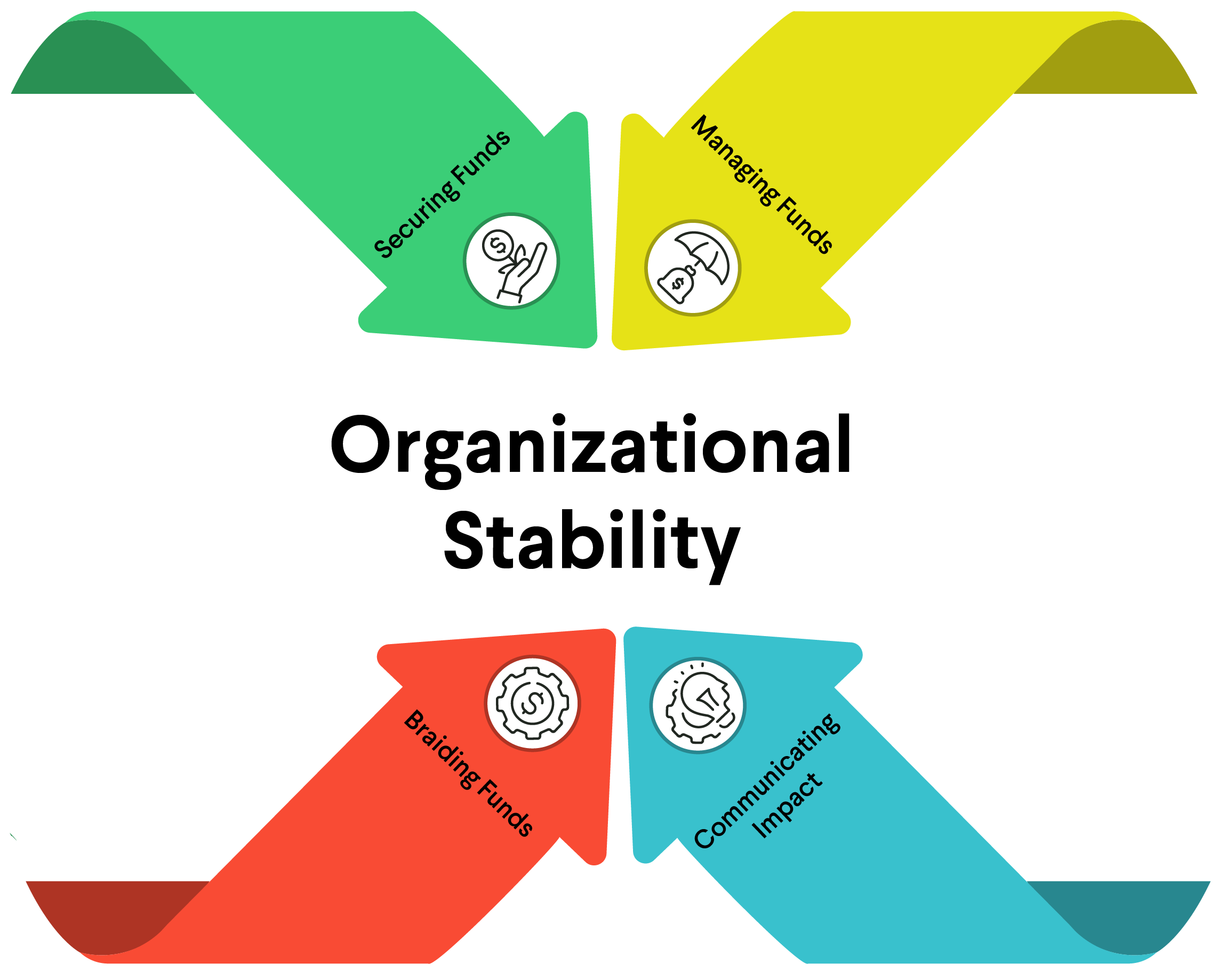
The sustainability toolkit includes guides, templates, best practices, and case studies that support organizations across four lifecycle phases:
Infographic with four colorful arrows labeled: Securing Funds, Managing Funds, Building Funds, Communicating Impact. Each section contains an icon related to its label.

A hand holds a plant with a dollar sign, symbolizing financial growth.Icon of a bag with a dollar sign under an umbrella, enclosed in a yellow circle, symbolizing financial protection or insurance.Gear icon with a dollar sign inside, outlined by a red circle.Line drawing of a light bulb inside a human head silhouette, overlapping with a gear, all enclosed in a turquoise circle.

Securing Funds


Managing Funds


Braiding Funds


Communicating Impact


Funder cultivation and exploring new funding opportunities

Effectively managing the spend down of grants

Optimizing the use of multiple funding sources

Capturing and communicating impact of organizations’ programs


A hand holds a plant with a dollar sign, symbolizing financial growth.

Securing Funds

This section of the toolkit offers guidance and resources to assist organizations in diversifying their funding sources. It covers topics such as securing private philanthropic funding, aligning your organization with funders’ priorities, engaging with your local workforce development board, and setting up a fee-for-service model. Nonprofits, community-based organizations, and other service providers seeking practical resources and templates to help secure additional funding to strengthen their organizational capacity and resilience will benefit from this resource.

How to Identify Philanthropic
Funding Sources

A group of people sit in an office having a discussion. A woman holding papers gestures while speaking to a man with a laptop. Other participants are listening and taking notes.

This resource offers guidance and tools for prospect research to identify private philanthropic funding sources aligned with your mission and fundraising goals.

Making the Case That Your HRTP Is Aligned With a Funder’s Priorities

Two colleagues in a modern office, one with short gray hair and another with a beard, discussing with documents and a laptop on the table.

This tool explains how to effectively make your case to funders, whether they explicitly focus on workforce development or have other priorities.

Collaborating With the Public Workforce System in California

Two men smiling while looking at a tablet outdoors, with another person in the background.

This tool offers guidance for nonprofit workforce organizations on how to collaborate more effectively with local workforce development boards.

Strategic Funder Communications
and Outreach

Two people in business attire are engaged in conversation near a window. The woman is holding a folder and smiling, while the man listens attentively.

This resource offers a guide for nonprofits on strategic communication and outreach with new funders.

Securing Unrestricted Funds Through a Fee-for-Service Model

Person wearing glasses and a white shirt, holding a card while working on a desktop computer in an office setting.

This resource shows how nonprofits can use a fee-for-service model to secure unrestricted funds and reduce reliance on restricted public and philanthropic funding.


Icon of a bag with a dollar sign under an umbrella, enclosed in a yellow circle, symbolizing financial protection or insurance.

Managing Funds

Effective financial management is critical to sustaining an organization’s work and ensuring compliance with grant requirements. This section helps organizations assess their capacity and skills for managing funds, guiding decisions on whether to handle financial management internally or outsource. It also provides strategies for effectively managing grant spend-down, ensuring public funds are allocated and utilized within the required time frame and in alignment with grant agreements. By understanding these key aspects, organizations can strengthen financial oversight, support long-term sustainability, and maximize their impact.

Capacity and Skills Needed to Manage Funds

Two women sitting at a table in an office setting, engaged in conversation. One is holding papers, and both appear to be smiling.

This tool offers guidance on how to evaluate the capacity and skills needed for effective financial management of grants.

Effectively Managing Public Grant Spend-Down

Hands reviewing charts and graphs on paper, with a cup of coffee on the table.

This resource shares strategies for spending down grants to ensure compliance, prevent fund retraction, maximize impact, and strengthen future funding opportunities.


Gear icon with a dollar sign inside, outlined by a red circle.

Braiding Funds

This section outlines the case for braiding funds, provides additional resources to support organizations interested in braiding funds, and features a case study of how a High Road Training Fund grantee leveraged multiple funding sources to scale its program.

Braiding Funds Overview and Case Study

Close-up of a hand holding a pen near a calculator, with a laptop in the background and paperwork showing graphs on a clipboard.

This resource explores braided funding as a strategy to sustain community organizations and includes a case study on how a nonprofit applied this approach.


Line drawing of a light bulb inside a human head silhouette, overlapping with a gear, all enclosed in a turquoise circle.

Communicating Impact

This section of the toolkit empowers organizations with essential tools and insights to unlock a deeper understanding of their impact through effective tracking, collection, and analysis of data. Beyond numbers, it also reveals powerful strategies for crafting compelling stories that bring the organization’s impact to life and tailoring that messaging to the specific interests of various audiences.

Understanding Your Organization’s Impact

Three people in an office discuss around a desk. One person gestures while speaking. They hold documents and a tablet, with a computer screen in the background.

This resource provides guidance and tools to help deepen your organization’s understanding of your impact and how to effectively demonstrate it.

Storytelling for Impact

A group of people sits in a row, smiling and listening attentively. The focus is on a bearded man in glasses and a blue shirt.

This guide offers examples of practical approaches to tailoring your impact story to reflect the interests and priorities of a wide range of specific audiences.