Skip to content
Three people sit at a table, smiling and talking while holding papers, with another person sitting in the background.
Impact Story

From Textile Waste to Community Wealth

How Western North Carolina is Reclaiming its Manufacturing Legacy Through Worker-Owned Innovation

September 23, 2026

At a Glance

The Industrial Commons shows how a rural community can reclaim its manufacturing legacy while building economic opportunity that is accessible, environmentally sustainable, and locally rooted.

Contributors
Lee Domeika Director

Overview

The Industrial Commons (TIC), a network of workforce and arts programs in western North Carolina founded in 2015, demonstrates how a rural community can reclaim its manufacturing legacy while creating local economic opportunities that are accessible and regenerative. Following the closure of textile factories in the 90s and the subsequent loss of thousands of jobs to offshoring, TIC began reimagining the region’s future by transforming textile waste into value, fostering worker ownership, and strengthening community connections through arts and culture.

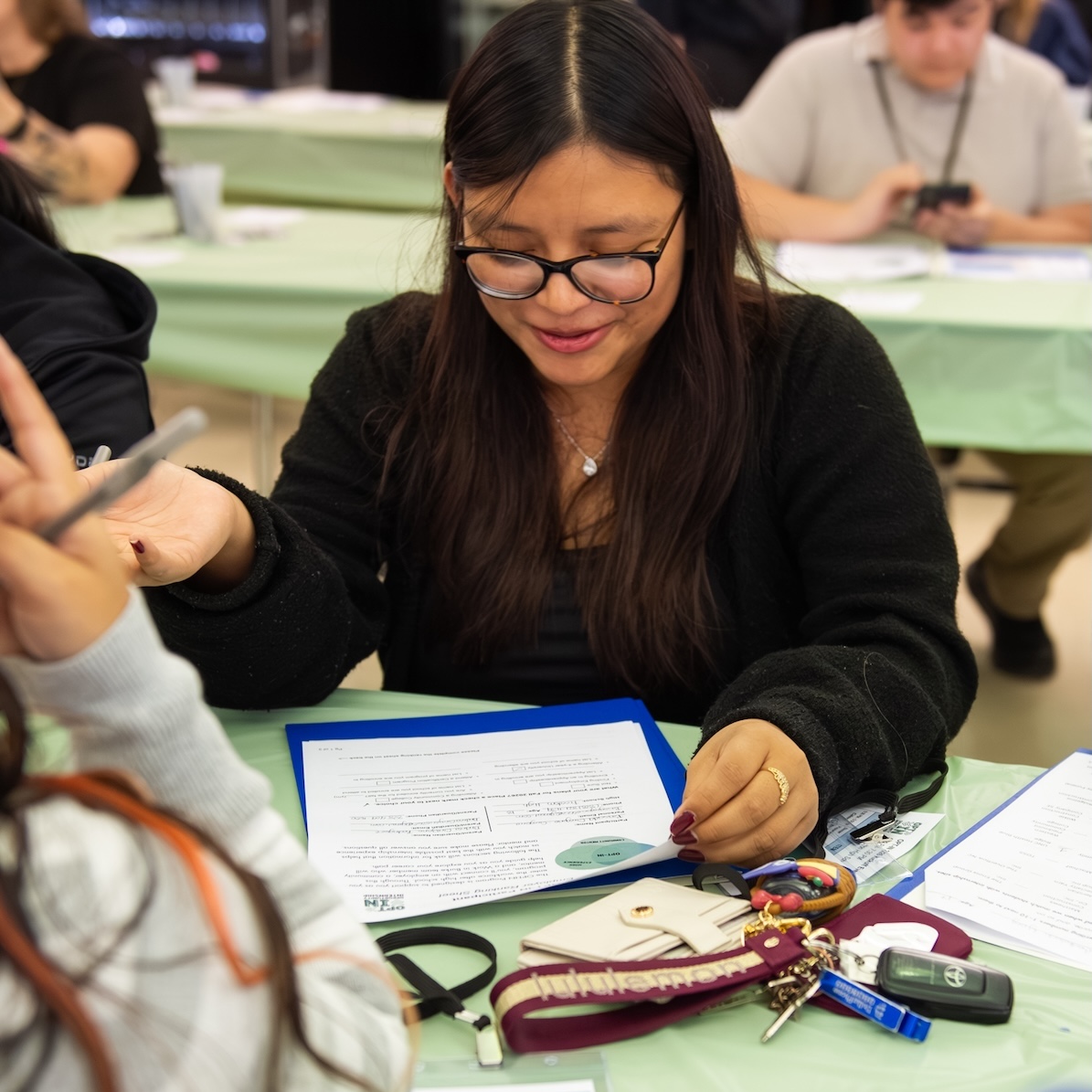
A woman with glasses reviews documents at a table, holding a pen. Keys, a phone, and a wallet are on the table beside her. Other people are present in the background.

Rather than addressing challenges through isolated interventions, TIC has built an interconnected model for rural economic development with support from JFF’s Climate-Resilient Employees for a Sustainable Tomorrow (CREST) initiative. Material Return converts textile scraps worth pennies into yarn worth hundreds of dollars. Opportunity Threads creates pathways to worker ownership and leadership while Work in Burke connects residents to training and employment opportunities. Through TOSS, TIC also uses arts-based engagement to foster civic participation and support community-driven workforce development.

“This partnership is a powerful example of how education, industry, and technology can come together to shape the future of American manufacturing.”

– Wasef Awad, worker-owner and plant manager Valdese Weavers, a TIC employer partner

Amid shifting federal priorities and funding uncertainty, TIC has maintained continuity of services and minimized disruptions to participant training, supported in part by CREST’s unrestricted funding. This stability has enabled continued growth across programs. TIC’s Work in Burke OPT-IN initiative, which provides recent high school graduates with an eight-week workforce exploration internship, has expanded employer participation from 14 to 38 businesses and grown its mentor network to more than 40 individuals. This summer, 60 interns are participating in placements, aided by a new school engagement strategy that resulted in 10% of the graduating class enrolling at kickoff.

TIC is also helping build the next generation of manufacturing talent through its Apparel and Textile Fundamentals curriculum, developed in partnership with the North Carolina Department of Public Instruction and textile educators statewide. More than 80 instructors have been onboarded, over 70 trained through in-person events, and the curriculum is expected to reach 5,000 students annually. Additionally, TIC has broadened access to its Industrial Sewing Program through an evening and weekend schedule at the Morganton campus, as well as offering classes in Spanish, culminating in the successful graduation of the inaugural cohort of eight participants and successful job placement of two students.

TIC’s impact across these programs is reflected in the experience of Jacob Lail, an OPT-IN alumnus who recently transitioned from an internship at Material Return to a full-time role as a Material Handler. During his internship, he also completed TIC’s Industrial Sewing Program and developed valuable technical skills in textiles and materials handling. Despite transportation challenges, Jacob remained committed to his career goals and continues to thrive in his position nearly one year later.

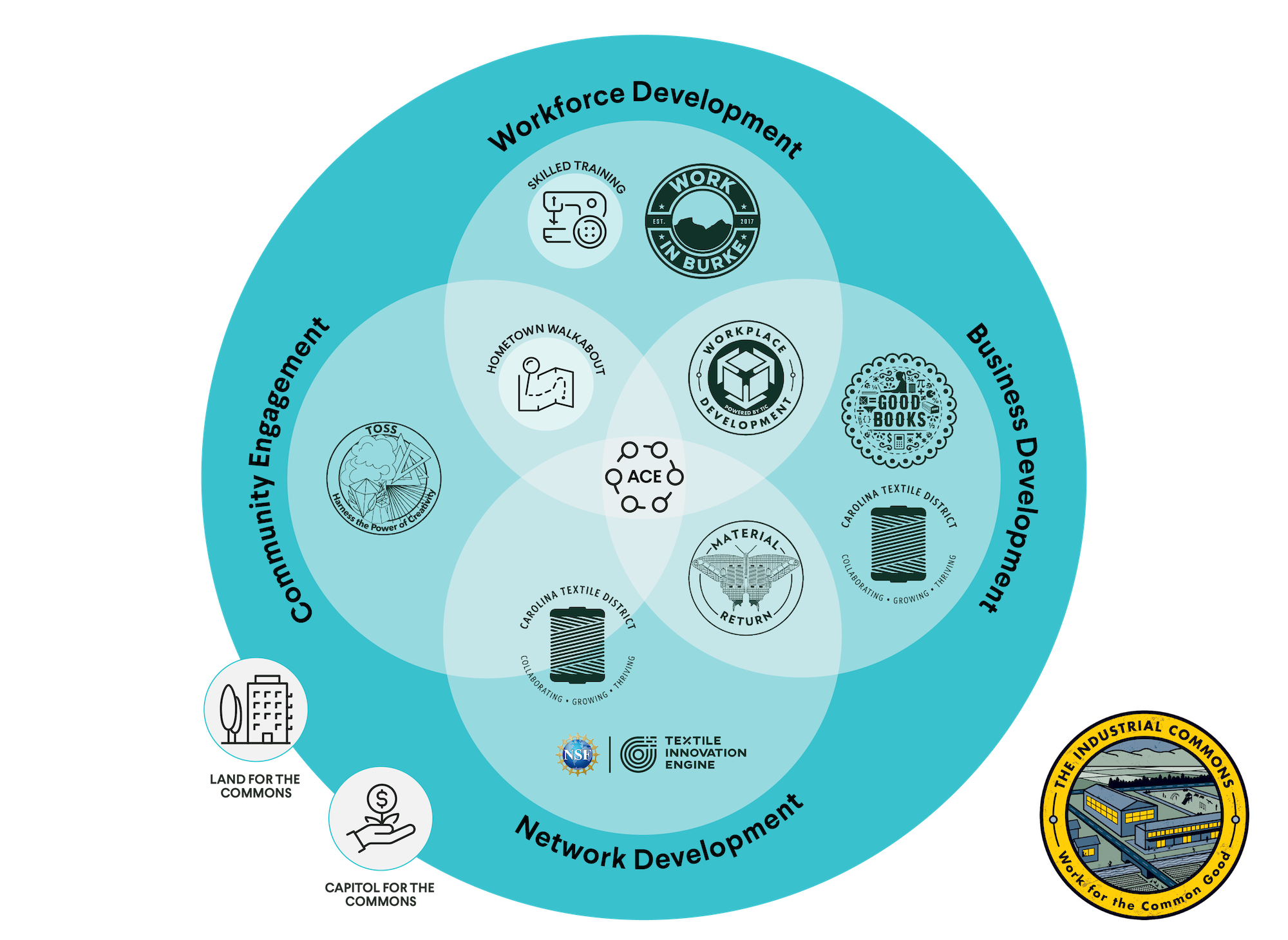
A Venn diagram with overlapping sections labeled Workforce, Business, Network, and Community Development, showing logos and icons representing different programs and organizations.

Together, these initiatives create pathways to both economic opportunity and social transformation, positioning The Industrial Commons as a model of rural resilience, innovation, and community-led workforce development.

Core Elements of the TIC Model

A person wearing a safety vest and headphones inspects clothing items in a cardboard box at a warehouse.

Worker Ownership

Enterprises structured as worker-owned cooperatives ensure profits and jobs stay local, wages flourish, and leadership capacity grows

Three people stand around a table with yarn samples and a “Material Return” poster about circularity. The display is numbered 17 and set against a red and beige wall.

Circular Economy

Turning textile waste into value through recycling and reuse transforms environmental problems into economic opportunities, aligning profit with sustainability

A person speaks at a podium beside a screen displaying logos of 2026 OPT-IN employers, with another person signing to an audience in an auditorium.

Training → Employment

Workforce pipelines link technical training with real job opportunities, while embedding cooperative and leadership skills

A large group of people gather in a spacious indoor area, standing and talking in small groups near tables with snacks and drinks.

Arts & Culture as Organizing Tool

Creative expression can spark civic pride, build relationships, and strengthen collective problem-solving

A woman in a pink floral dress shakes hands with a young woman on stage at an award ceremony. Other young women stand nearby holding certificates and clapping.

Community Asset Ownership

Controlling land, facilities, and housing anchors economic transformation, ensuring that infrastructure supports community wealth rather than extraction

People at a check-in table interact with attendees. The man in front wears a light blue shirt with a badge and gestures while speaking. A sign reads “Check-In E-M.”.

Strong Governance & Organizational Systems

Durable models require more than visionary ideas; they need sound governance, transparent processes, and investments in people and systems that sustain long-term growth and embrace endemic culture

Student Voices, Expanding Futures

For participants, TIC’s model is not experienced as a set of separate programs, but as a network of relationships and opportunities that helps them imagine a future for themselves in western North Carolina. Students described finding the program through school-based outreach, teachers, and peers, then discovering that it could offer more than just a summer placement.

Nigel, a participant of Work in Burke’s OPT-IN program, shared that before joining, he was “working in various fast-food restaurants” and “thinking of going into a factory,” underscoring how many young people come to TIC at an in-between moment, looking for clearer direction and better options. For some, the experience created immediate clarity about what they wanted next. For others, the impact was more transformative. Josh, who initially participated in OPT-IN and is now with the Work in Burke team, reflected that OPT IN “completely changed my future,” capturing how TIC’s workforce model helps young people connect training and work experience to a stronger sense of direction and possibility.

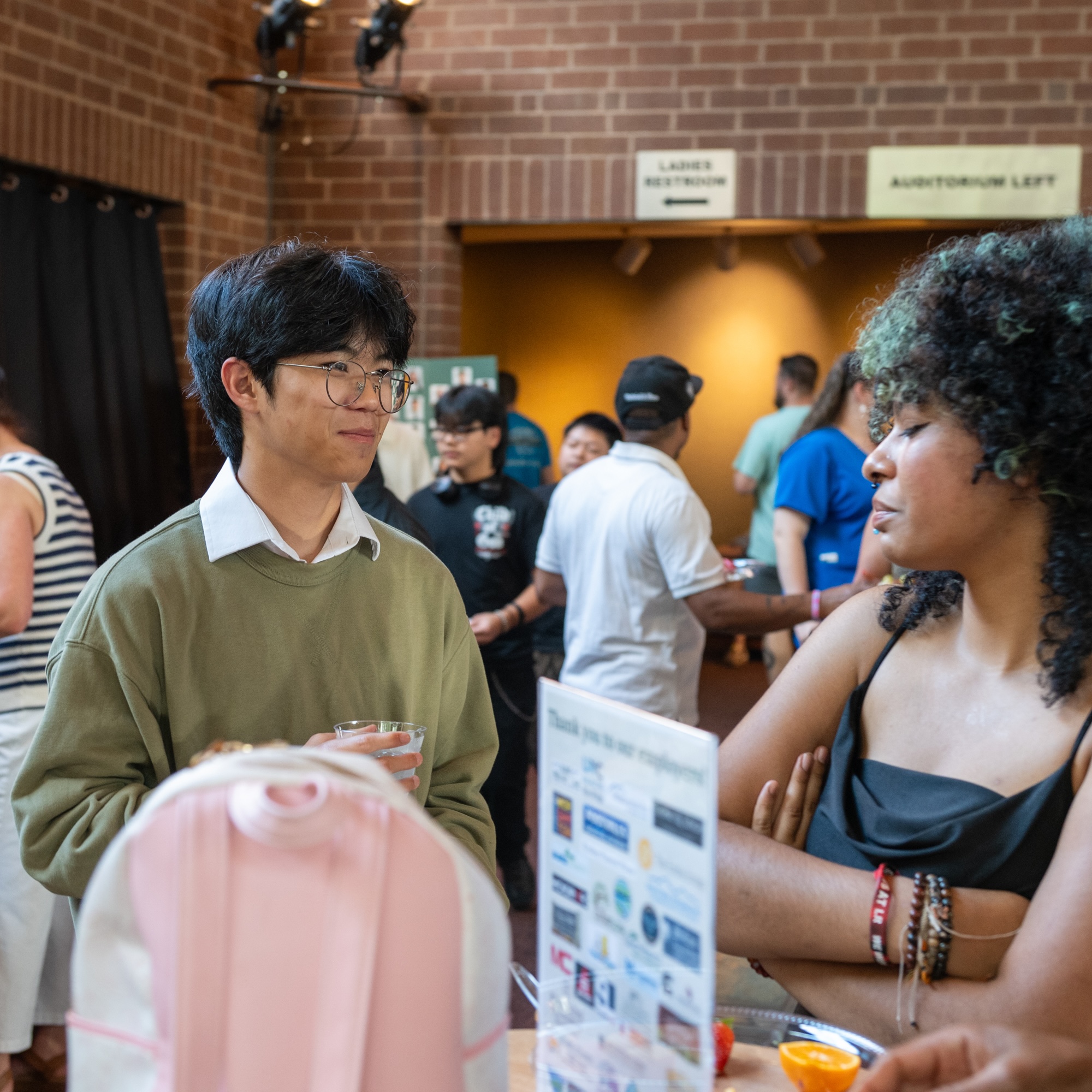
Two people stand and talk at an indoor event near a table with a sign and drinks. Other attendees are visible in the background.
Student: Nigel Lee

Just as importantly, students described TIC’s approach as deeply relational. Participants spoke about mentors and staff who helped them manage stress, stay engaged, and navigate barriers ranging from scheduling to transportation. Nigel said the program helped him “get out of [his] comfort zone,” while Yesenia, who came to TIC through the STRIVE scholarship program and Work in Burke, emphasized how meaningful it was to be recognized in her placement: “the fact that she knows my name, it feels good.”

“I have a two-year-old daughter, and since working with OPT-IN, I have gained experiences that I share with my daughter and she in turn learns new things. I am excited to see what she will see in her future, and I am just so happy to have her.”

– Inez, an OPT-IN participant, on how her growth also had an intergenerational dimension

These reflections reinforce what makes TIC’s model distinctive: workforce development is paired with real care, trusted relationships, and consistent support, making opportunity feel both practical and personal.

Across their reflections, students emphasized the human side of TIC’s larger theory of change. The same ecosystem that includes employer partnerships, curriculum, technical training, and expanded access also helps young people build confidence, networks, and momentum toward longer-term goals.

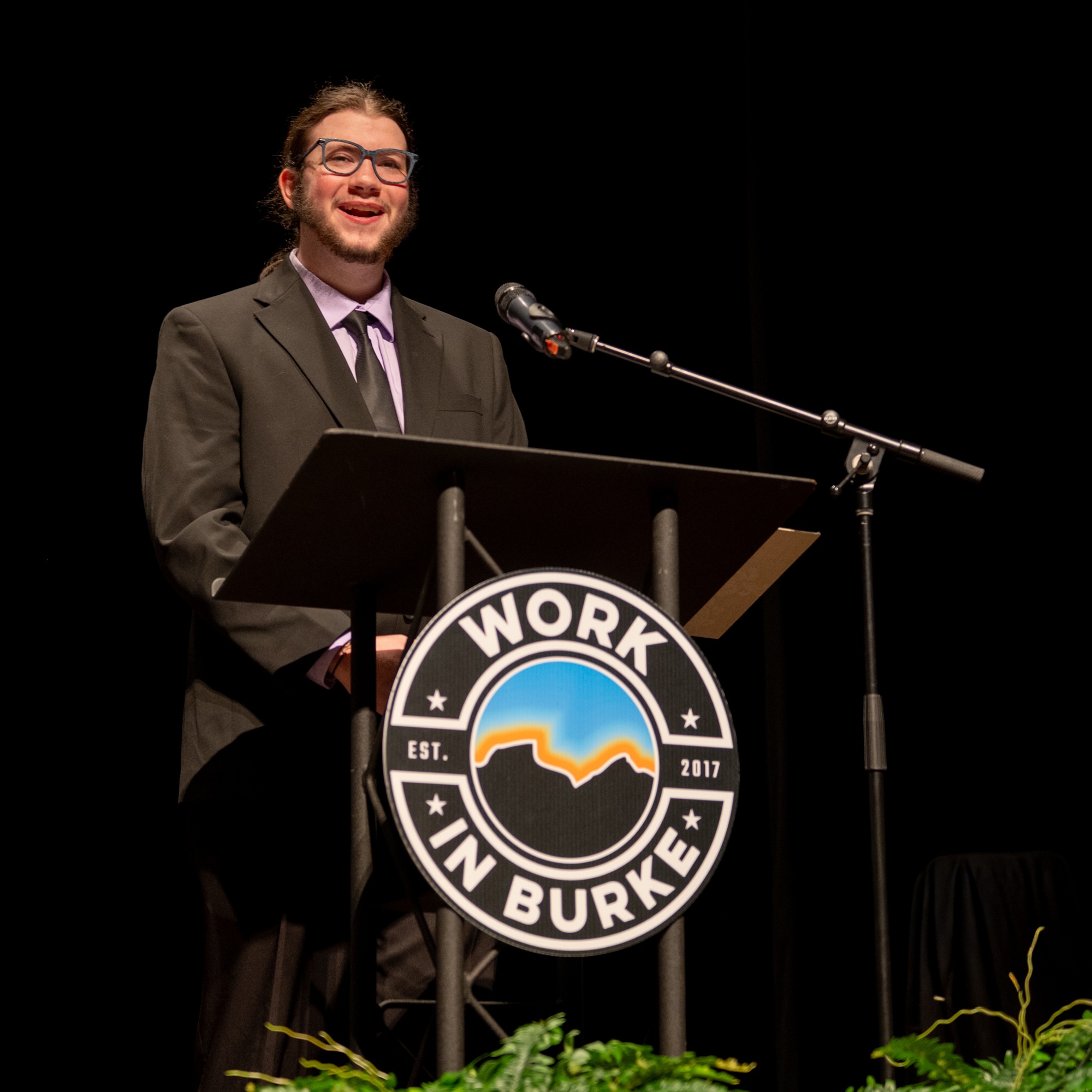
A person in a suit stands at a podium with a “Work in Burke” sign, speaking into a microphone on a stage.
Student: Alexander Christopher

Alexander, another OPT-IN participant, described the value of being able to put his learning to use, while students across programs spoke about gaining skills, feeling “seen” and beginning to move toward a better future. Their reflections also indicate the potential impact of this model beyond a single community. As Jacob, an OPT-IN participant shares, “Hopefully we have more Work in Burke programs everywhere.” In that sense, their stories echo TIC’s broader vision: creating pathways to economic opportunity that are not only locally accessible, but rooted in dignity, belonging, and community wealth.

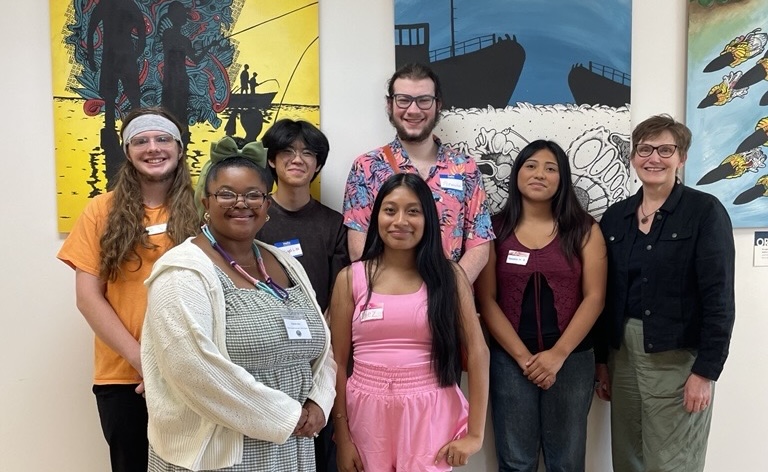
Seven people stand in front of colorful artwork, posing for a group photo. Most wear name tags and are smiling.

Students (from left to right): Josh Torebka, Nigel Lee, Christopher Alexander, Inez Chan Mejia, and Yesenia Mendoza Rodriguez, and instructors from the OPT-IN and Worke in Burke programs pose for a photo at the Industrial Commons

What Partnership Can Look Like

Use the drop-down to see how TIC has built intentional partnership across a variety of stakeholders.

Local workers

What Partnership Can Look Like

Worker-owners, participants, mentors, and community leaders who help shape programs and enterprise development.

Lesson Learned & Best Practices

Design with workers, not for workers; worker voice and lived experience make programs more relevant, build trust, and strengthen pathways to ownership and advancement.

Enabling Strategies for Effective Partnership

Create meaningful worker leadership roles; compensate workers for their expertise; provide coaching, financial education, and clear pathways to ownership and advancement.

Owners, leaders, entrepreneurs

What Partnership Can Look Like

Provide cooperative ownership pathways and leadership training.

Lesson Learned & Best Practices

Ownership is both a business strategy and a workforce strategy; entrepreneurs and workers need technical assistance, peer learning, and access to patient capital to build locally rooted enterprises.

Enabling Strategies for Effective Partnership

Pair leadership development with business coaching, cooperative education, and flexible capital through initiatives such as Capital for the Commons.

Education & workforce agencies

What Partnership Can Look Like

Training providers

Lesson Learned & Best Practices

Link skills training and curriculum directly to local jobs and embed cooperative principles.

Enabling Strategies for Effective Partnership

Embed cooperative principles; coordinate employers, community colleges, workforce agencies, and wraparound support.

Local government & private funders

What Partnership Can Look Like

Supportive infrastructure for flexible funding

Lesson Learned & Best Practices

Innovation often happens at the intersection of public resources, philanthropy, and locally rooted organizations being able to accomplish work outcomes together.

Enabling Strategies for Effective Partnership

Invest in innovative technologies, cooperative startups, workforce pipelines, and community assets; provide multi-year, flexible funding that allows partnerships to adapt and grow.

Artists & cultural organizers

What Partnership Can Look Like

Bridge-builders

Lesson Learned & Best Practices

TIC’s TOSS programming demonstrates how art and creative practice can bring workers, young people, businesses, and residents together across traditional silos.

Enabling Strategies for Effective Partnership

Use creative projects to foster civic engagement and trust; compensate artists as partners; create shared spaces and experiences where people can build relationships.

Employers

What Partnership Can Look Like

Market partners

Lesson Learned & Best Practices

Employers must be active partners, not just hiring destinations; TIC’s strongest workforce pathways are built with employers who help define skills, provide work-based learning, and create real opportunities for advancement.

Enabling Strategies for Effective Partnership

Build local supply chains and reinforce a “wealth stays here” narrative; engage employers in curriculum design, apprenticeships, procurement, and worker ownership opportunities.

“We want to improve the now for our young people, but we also want them to have a better future.”

-Deisy Zavala Vazquez, Director of Work in Burke

Climate-Resilient Employees for a Sustainable Tomorrow (“CREST”) is a five-year, $25 million career preparation and reskilling initiative that aims to close the gap between the demand for a skilled workforce for jobs in emerging and high-growth industries and the number of people prepared for these opportunities. Working with our partners and local communities, we can deepen our impact, harness new opportunities, and help create a more prosperous, resilient future that benefits generations to come.

Jobs for the Future (JFF) transforms U.S. education and workforce systems to drive economic success for people, businesses, and communities.