Skip to content
A woman uses a laptop while sitting in a classroom with other attendees.
Post

From Accommodation to Redesign

Reimagining Postsecondary Education for Adult Learners

October 1, 2026

At a Glance

Eight California colleges are rethinking how they serve adult learners—simplifying complex systems, strengthening belonging, and creating more flexible pathways to credentials and economic mobility.

Contributors Practices & Centers

Throughout California and across the country, colleges are increasingly recognizing the need to adapt their programs and support structures for the growing population of adult learners seeking postsecondary credentials—including the 6 million Californian adults with some college but no degree. Even while juggling responsibilities for work and family, these adult learners, defined as those over age 25, enroll in postsecondary education to obtain economic opportunities and financial security for themselves and their families. Unfortunately, they too often encounter a collegiate support system that all too often consists of layers of new programs and processes tacked onto structures that were never designed for them.

JFF is partnering with College Futures Foundation on the Unlocking Economic Mobility for Adult Learners initiative to tackle this problem at the fundamental level: shifting from accommodating adult learners to redesigning the learner experience. The proposed solutions developed by grantees include changing policies and structures, simplifying processes, and using technology and AI in ways that strengthen, not replace, human connection and belonging. The hallmarks of this redesigned experience would be affordability, flexibility, and belonging; the outcomes would be credential completion and economic mobility.

These grantees, who include representatives from the California Community Colleges, California State University (CSU), and University of California (UC) systems, were selected because of their commitment to institutional transformation. Together, they are reimagining what the college experience might look like for the 6 million Californian adults without a postsecondary credential. While the grantees are just starting their work, there are already key themes emerging:

Theme I: The real barrier is complexity

Complexity is embedded across the student journey. When our cohort meets, they frequently come back to the bureaucratic hurdles facing adult learners, especially in re-engagement, onboarding, advising, and providing credit for prior learning. This bureaucracy is typically a byproduct of the way that colleges grow and evolve, layering on new structures, policies, and processes. Most often, these additions are designed around the needs of administrators, not learners. As Ideas42 shared in an early peer-learning session, bureaucratic hurdles like these reflect an “additive bias” common in educational institutions—even though some of the most impactful interventions are those that subtract processes and tasks to reduce learners’ cognitive load. The end result is a complex and opaque system.

“And there was a lot of discouraging moments where, you know, I just didn’t know where to go or where to reach.”

– Maritza Avila, Nursing Student, College of the Desert*

This complexity affects many students but has an outsized impact on adults who are juggling limited time between work, family, and other obligations. Confusion about requirements, essential forms, extra steps, unclear deadlines, and scheduling challenges can easily push an adult learner to conclude that they are just not cut out for higher education. Examining the adult learner experience can therefore expose deeper structural problems within current institutional systems.

A group of colleagues collaborating around a table with laptops in a bright, modern office.

Theme 2: The real work is operationalizing the adult-centered learning experience

Collectively, cohort members know what adult learners need:

  • An educational experience that includes personalized support across the full learner journey, from re-engagement through credential completion and transition to the workforce;
  • Seamless and flexible pathways, including multiple learning modalities and recognition of prior learning; and
  • Clearer connections to economic opportunities.

“They told me, don’t worry about that, Steven. We’re going to walk you through this. We’re going to hold your hand if we have to . . . And at first I was like, yeah, right. But literally not even within an hour of talking to my guidance counselor, I already had my student number, I’m enrolled, I got my classes, I got my schedule. I couldn’t believe it.”

– Steve Castro, student speaking on his experience at a tribal college in California*

Given the complexity baked into educational institutions, operationalizing the adult-centered learning experience involves rethinking nearly every step of the adult learner journey.  While this is no simple task, between the grantees’ proposals and our early calls with colleges and other partners, we are seeing early signs of the capabilities and conditions that can support transformation:

  • Data systems that make adult learner outcomes visible.
  • Leadership that recognizes adult learner needs as a strategic imperative and makes visible their commitment to this community.
  • Cross-campus collaboration that addresses the full adult learner experience rather than isolated touchpoints and standalone strategies.
  • The strategic use of technology in a coherent, adult-centered model.
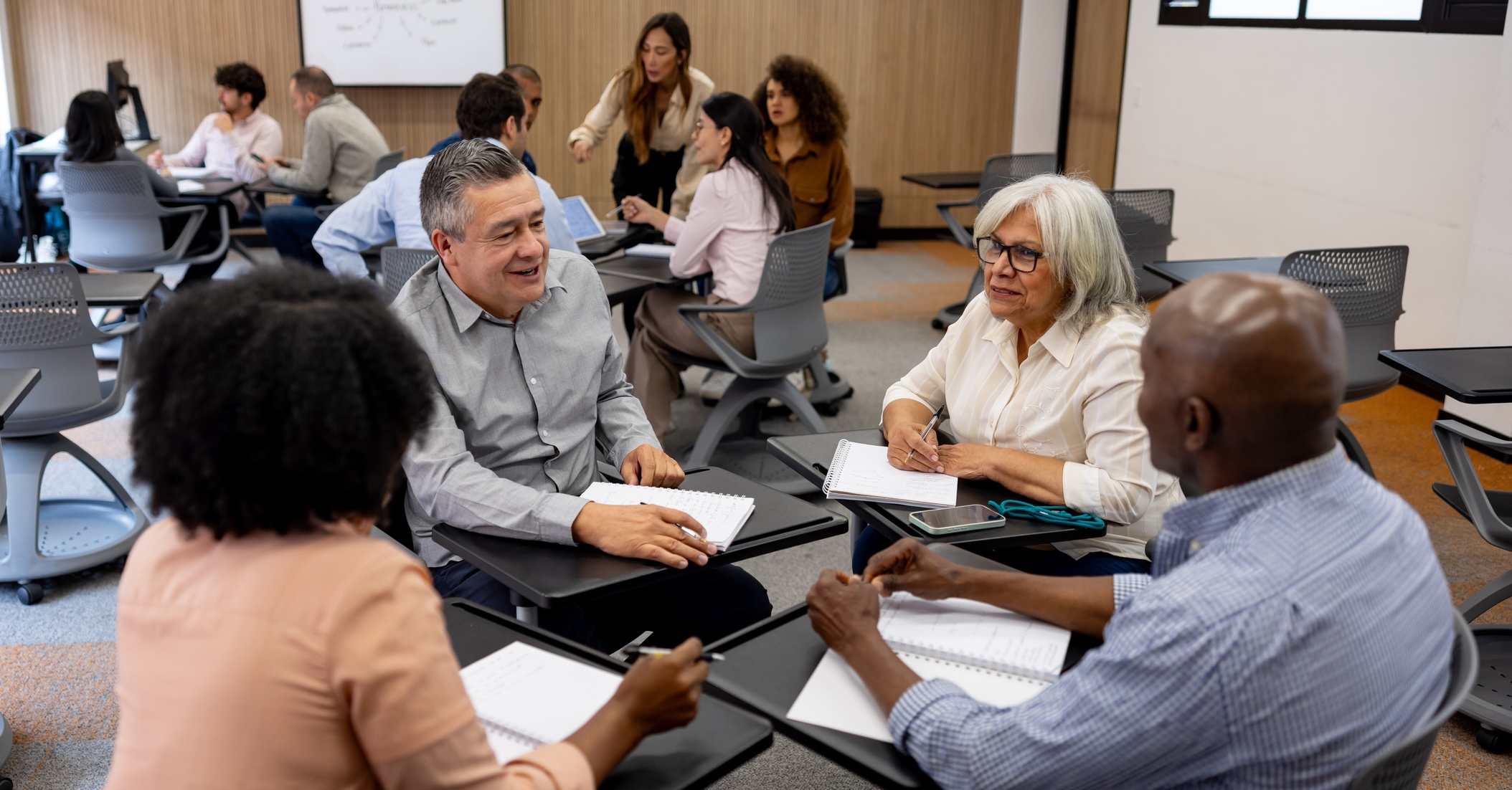
A diverse group of adults in a classroom setting sitting at desks, engaged in a discussion.

Theme 3: The real progress happens after the short-term workaround

Confronted with real barriers, staff often just work harder. They put in longer hours, and they make creative band-aids, custom processes, and local fixes to help learners navigate complex systems. These approaches reflect the dedication that college staff have to their students, and while their solutions are often effective in the short term or with a handful of students, they are not always scalable or sustainable. Individual champions are important, but the most important goal is redesigning the adult learner journey so that the workarounds are no longer needed.

We are currently seeing this dynamic of patchwork solutions play out in how colleges use technology, including AI. Colleges recognize the value of technology and AI for streamlining re-engagement, onboarding, advising, and access to information. They are especially excited about the ways that technology can free staff to do the high-value work that only people can do. The grantees provided multiple examples of creative, homegrown technological tools that reduce administrative and learner burdens—for example, tools that analyze student transcripts to identify opportunities to earn credit for prior learning. In the absence of an institutional redesign, these tools are necessary, but currently, the result is a patchwork of custom-built solutions rather than a well-designed system. AQL Labs, which joined a peer-learning session in July, challenged grantees to think differently about how and when to use AI, noting that when institutions redesign strategically around AI, rather than simply layering AI onto outdated systems, they may actually need AI less often.

Staff workarounds frequently signal to institutional leaders where redesign is most needed, so the next step is to use these patches as a starting point. After examining the complex situations that staff are trying to mitigate, leaders can design new processes that create the learning experiences that colleges want for all students.


A woman with curly hair studying at a laptop and open book in a library.

Conclusion

Across the eight colleges participating in the Unlocking Economic Mobility for Adult Learners initiative, we are seeing the beginning of an important shift: From thinking of adult learners as a niche population to be accommodated with add-ons to using the adult learner experience to redesign institutions in ways that will benefit all learners. Stay tuned to hear more from this cohort as they continue to learn and redesign the educational experience together.

*These quotes come from conversations College Futures Foundation has had with dozens of working learners across California this year, as part of its storytelling work to understand their experiences with postsecondary education, the barriers they face and what they believe needs to change.

Interested in staying connected with the broader postsecondary field? Join ELEVATE, a national network convened by Jobs for the Future (JFF) that brings together state, institutional, and field leaders working to strengthen postsecondary education and expand economic mobility.

California Working Learner Week

Beginning October 5, College Futures Foundation will bring partners across California together for California Working Learner Week, a statewide spotlight on the experiences, goals, and contributions of working learners. The week will feature learner stories, new research, events, and other resources that highlight how organizations are responding to the realities of adults balancing work, family, and education. Follow CFF to learn more and find ways to engage.
Jobs for the Future (JFF) transforms U.S. education and workforce systems to drive economic success for people, businesses, and communities.