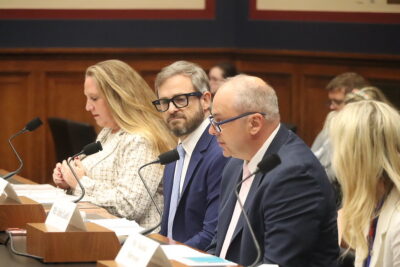
Good morning, Chairman, Ranking Member, and Members of the Committee. Thank you for the opportunity to testify today on the future of Registered Apprenticeship in the United States.
My name is John Ladd, and I serve as Senior Advisor at Jobs for the Future’s Center for Apprenticeship & Work-Based Learning. Before joining JFF in 2025, I served as Administrator of the U.S. Department of Labor’s Office of Apprenticeship across four administrations, both Republican and Democratic. Over that period, I saw apprenticeship evolve from a niche training approach associated primarily with the skilled trades into one of the nation’s leading workforce strategies. That experience has only deepened my view that apprenticeship has enormous promise, but that the country will not achieve the scale it now seeks without a more modern, better aligned, and more durable national framework to meet those goals.
JFF is a national, nonpartisan organization that works to transform workforce and education systems so that more people can access economic advancement and quality jobs. Through the center, JFF serves as a national apprenticeship policy, research, field-building, and technical assistance partner, helping employers, industry associations, states, workforce boards, education institutions, labor-management partnerships, related technical instruction providers, and community-based organizations design, launch, expand, and improve apprenticeship systems and programs. Next year will mark the center’s 10-year anniversary, representing a decade of focused leadership to expand and modernize apprenticeship across the United States.
JFF believes strongly in the power and future of Registered Apprenticeship and work-based learning broadly. Since the establishment of the center, JFF has helped develop or expand apprenticeship efforts in 40 states, engaged more than 3,300 employers and sponsors, created more than 155 programs and more than 300 resources, and supported more than 14,000 apprentices, including more than 1,760 young people entering Registered Apprenticeship programs including 37% of apprentices from populations that are statistically underrepresented in apprenticeship, including women, youth, veterans, and people with disabilities. This breadth of work matters because it means JFF sees apprenticeship from multiple vantage points at once: as a policy and funding priority, as an employer talent strategy, as a youth pathway, as a postsecondary pathway, as a unique public-private partnership, and as a workforce development system that requires durable infrastructure.
Our body of apprenticeship work includes serving as the U.S. Department of Labor’s manufacturing industry intermediary, helping expand Registered Apprenticeship across advanced manufacturing and agriculture by supporting more than 5,600 apprentices across 35 states and Puerto Rico, launching more than 40 new Registered Apprenticeship programs, engaging hundreds of employers, and providing roughly $2.25 million in employer incentives to offset training costs. It includes serving as the U.S. Department of Labor’s Youth Apprenticeship Intermediary, through which JFF established 47 new local apprenticeship programs, added 47 youth elements to a national program, supported 1,763 youth apprentices, and helped launch Oregon’s first registered youth apprenticeship program. It includes JFF’s Apprenticeship Expansion and Modernization Fund and Apprenticeship Building America work, through which JFF has expanded access to apprenticeship for youth by enrolling 701 young people who are not working or in school into Registered Apprenticeship through AEMF and, through ABA, enrolling 122 apprentices and 935 pre-apprentices while supporting 696 pre-apprentice completions and creating and expanding new apprenticeship and pre-apprenticeship pathways. It also includes JFF’s broader field-building work on youth pathways, expanding access in apprenticeship, and postsecondary-connected apprenticeship models, including degree apprenticeship approaches that connect paid work, college credit, and advancement. JFF has consistently delivered results on promoting innovation and expanding apprenticeship and we look forward to working with DOL to continue these efforts.
Apprenticeship is no longer a niche strategy—it is one of the clearest ways to connect education, work, and economic mobility at a moment when the limits of a college-for-all approach are increasingly clear, and the age of AI is making skill-building, adaptability, and real-world experience even more important. It delivers value for workers, employers, and the public alike. And in this 250th anniversary year, Congress has a chance to strengthen a model for the future that reaches back to the founding itself: apprenticeship helped shape early American opportunity, including for several Founding Fathers who began their working lives as apprentices.
If Congress wants apprenticeship to reach its full potential, it must modernize the framework, strengthen the pathway, and invest in the durable infrastructure needed for national growth. My testimony makes five core points and asks Congress to act on them:
- Apprenticeship is a proven bipartisan strategy that delivers value for workers, employers, and the public.
- The United States has made real progress, but current growth has slowed and the country is not on pace to reach one million active apprentices without deliberate intervention.
- Scaling apprenticeship will require clearer roles across the national ecosystem, including for the federal government, states, industry, intermediaries, and education partners.
- Apprenticeship should be built as a connected pathway system linking pre-apprenticeship, youth apprenticeship, Registered Apprenticeship, and degree apprenticeship, with no dead ends for learners and workers.
- Congress should reauthorize the National Apprenticeship Act and pair that modernization with sustained investment, stronger employer incentives, better data, and a long-term national growth and innovation strategy.