Skip to content
Two people on a boat pull fishing nets from a container with the ocean visible in the background, under natural daylight.
Impact Story

Paid Apprenticeship Leads to a Dream Jobs in Coastal Maine

July 29, 2026

At a Glance

With JFF’s support:

  • More than 700 young people completed a pre-apprenticeship or Registered Apprenticeship.
  • 10 youth-serving organizations received funding, coaching, and peer learning to expand apprenticeship programs.
  • Andrew Hoffman of Maine met his goal to launch a career in aquaculture.
Contributors Practices & Centers

Andrew Hoffman’s passion for sustainability led him from the Midwest to Maine, a degree in environmental studies, and a dream of running his own shellfish farm. But as he applied for jobs after graduation, he realized he had no idea how to get started.

So when he heard about a paid, hands-on training program for young people to get a taste of oyster and mussel farming along the Maine coast, he jumped at the chance. The three-month pre-apprenticeship—supported by Jobs for the Future’s partner, Educate Maine, through the Next Generation Apprenticeship for Next Generation Talent initiative—introduced Hoffman to the state’s burgeoning aquaculture industry, and he was hooked.

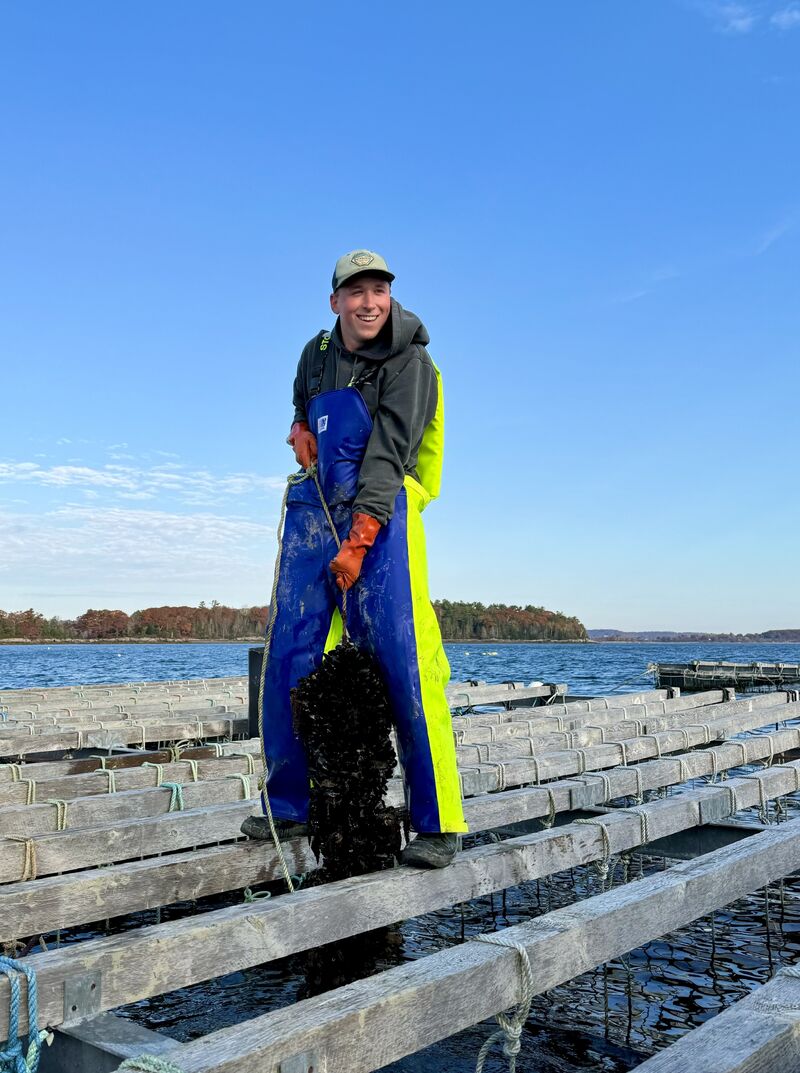
“You can’t really explain going out on a boat and harvesting mussels,” he said. “So you join a pre-apprenticeship program, and that’s when you figure out what the day-to-day is like. Everything was a shock when I started, but I loved working there.”

Person wearing a cap and waterproof overalls lifts a rope covered in seaweed on a wooden aquaculture platform by the water on a clear day.

Bangs Island Mussels, which hosted his pre-apprenticeship training, hired him as a full-time deck hand by the end of the summer. After a year, he decided to pursue a Registered Apprenticeship with the same company to prepare for an aquaculture career. The program requires 2,000 hours of paid on-the-job training plus related classroom learning through the Gulf of Maine Research Institute and the Maine Community College System; he was ready.

Now 24 years old, Hoffman is the farm operations and data manager; he’s in charge of forecasting, planning, and inventory—and he captains a 46-foot boat with a large crane and a crew.

Much of the work is rough physical labor, hauling ropes and repairing engines in the blistering sun and numbing cold. It’s been challenging to recruit the reliable, skilled workforce the industry needs to keep growing.

The Aquaculture Pioneers Pre-Apprenticeship is an earn-and-learn program run by Educate Maine. It offers 10-12 weeks of training, hands-on learning, and direct connections to the year-long Shellfish & Seaweed Aquaculture Technician Registered Apprenticeship. These programs are administered in partnership with The Maine Aquaculture Association, Gulf of Maine Research Institute, Maine Department of Labor, and the Maine Community College System, and with support from FocusMaine, The Builders Initiative, and the U.S. Department of Agriculture.

Educate Maine is just one of 10 youth-serving organizations JFF partnered with for eight years to create or expand pre-apprenticeships and apprenticeships serving young people ages 16 to 24. We provided funding, technical assistance, peer learning opportunities, in-person convenings, and monthly one-on-one coaching to support and expand their programming. We also established a Youth Council of Changemakers, a group of young people, including Hoffman, helping to shape more responsive and effective apprenticeship systems.

Hoffman’s career goals have evolved as he has learned the ins and outs of running a small business. He still wants to start his own shellfish farm someday, but he’s also interested in identifying and filling needs in the broader industry.

Thank you to the U.S. Department of Labor’s Employment and Training Administration for supporting this work.

This project is funded by the U.S. Department of Labor, Employment and Training Administration, as part of the Apprenticeship Building America grant totaling $5,310,000, with $2,003,460 financed from non-federal sources.

Jobs for the Future (JFF) transforms U.S. education and workforce systems to drive economic success for people, businesses, and communities.