Skip to content
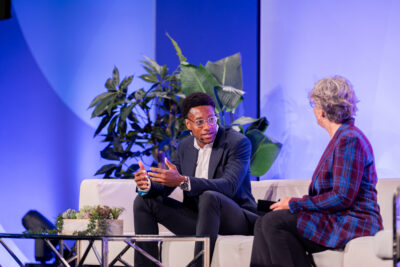
Two people sit on a white couch engaged in conversation on a stage, with green plants and a blue-lit background behind them.
Post

Eight Steps for a Stronger Future of Work

Horizons 2026: Moving fast, centering job quality, and building human connection will strengthen work in the AI age

August 20, 2026

At a glance

Main stage speakers such as Red Lobster CEO Damola Adamolekun, spaceflight crew member Aisha Bowe, and policymakers from both political parties urged decisive action at the 2026 Horizons Summit.

Contributors

On the second day of the 2026 Horizons Summit, hosted by Jobs for the Future (JFF), Senator Mark Warner offered attendees a call to action and a warning on the artificial intelligence transformation in the workforce.

“We’re not gonna get this 100% right,” Warner, a senator from Virginia and former telecommunications executive, told the 1,800 audience members. “But nothing would be worse than doing nothing.”

The summit began with JFF President and CEO Maria Flynn’s observation that, as the nation turns 250, “the American Dream remains a dream for far too many.” Over the next two days in Washington, DC, employers, policymakers, intermediaries, and innovators considered what has led to this lack of quality jobs and economic advancement—and what steps can drive big change and better outcomes.

1
Navigate with urgency

Employers, educators, startup founders, and government leaders all agreed: time is a luxury no one has when it comes to building a future of education and training that leads to quality jobs for more Americans.

“The half-life of expertise is shrinking and shrinking fast,” said Sonya Christian, chancellor of the California Community Colleges. “So we've got to move, and we've got to move quickly, because our time is now.”

Lydia Logan, the vice president for Global Education and Workforce Development at IBM, echoed the perspective: “We are going to have to do more, we're going to have to do it differently, and we're going to have to do it faster.”

2
Job quality is essential, not optional

For too long, quality jobs—offering workers financial well-being, workplace culture and safety, growth and development opportunities, agency and voice, and work structure and autonomy—have been considered a goal rather than a foundation. At Horizons, speakers argued that the mindset must change.

Damola Adamolekun, the CEO of Red Lobster, said that the hospitality business comes down to “very simply, guests and team”—and when the team experiences job quality, the entire business benefits as well.

“You want to make sure that people feel like they have a purpose in what they do, they enjoy the team that they work with, good people around them, and they trust the leadership,” Adamolekun said. “There’s a lot of soft stuff beyond how much you make that matters to people, and all of that contributes to the quality of the job.”

“There’s restaurants in every city, and you can choose any restaurant to work at,” he added. “So you have to be competitive, and you’re competitive by making the job higher quality.”
"As we build the workforce for tomorrow, let's remember that the future will belong to people and organizations that are willing to keep learning, adapting, and opening doors in new ways."

3
Apprenticeship works—it’s time to scale it

Registered Apprenticeship is a proven strategy for economic mobility—Henry Mack, U.S. Assistant Secretary of Labor, reported that apprentices, on average, earn $15,000-$20,000 more than their occupational peers with college degrees. It’s time to build on that momentum, said Myriam Sullivan, the associate vice president of JFF’s Center for Apprenticeship & Work-Based Learning.

“Today, more than 700,000 people are active apprentices across our nation—the most in our country's history,” Sullivan said. “If we're serious about reaching one million apprentices…. and ensuring those opportunities lead to lasting success, our work is far from over.”

With growing state and federal investments, apprenticeship intermediaries aspire to make apprenticeship a standard part of education and career conversations for young people.

“If we've been successful, the ecosystem will be speaking for itself,” said Kate Howell, the interim executive director of Educate Maine. “It will be out there and be accepted by everyone.”

4
Look for skills, not labels

A main stage highlight at Horizons was Aisha Bowe, the aerospace engineer and founder of STEMBoard, who traveled on the all-female Blue Origin spaceflight in 2025. In sharing her journey from community college to a graduate degree in space systems engineering, she advocated for taking a skills-based approach to helping people discover their passions and potential.

“I think they confused credentials with capability,” she said of the people who discouraged her from a career in STEM. “Your grades, your credentials, they tell you where someone has been, not necessarily what someone can do. To look at that piece of paper and say I don’t think you’re capable… that was a conclusion that was made far too soon.”

Raghu Krishnaiah, chief operating officer at the University of Phoenix, echoed the idea that a degree must represent skills, experiences, and outcomes, not just serve as a “piece of paper” that signals achievement.

“I think the degree is still going to be a component that people will want,” he said. “But the pathway to get there and what makes it up is going to fundamentally shift. And it will be focused on more of the value that people are trying to achieve from the learning as opposed to a piece of paper they're getting at the end of the day.”

5
Human connection is the key

Red Lobster’s Adamolekun reminded Horizons attendees that success in the hospitality business is built on interpersonal experiences, and that artificial intelligence ultimately needs to support that.

“People think we serve food, but what we serve is a guest experience. And a lot of that is human connection. And part of that is the interaction with the team at the restaurant—the manager, the GM, the servers, the hosts,” Adamolekun said. “The way I view AI, and technology in general, is to let them be better at that part of the job.”

Carrie Varoquiers, the chief impact officer at Workday, discussed the critical need to strengthen human connection and capability among early-career workers—even if the investment feels “cringey” at the start. “The teammate building activities that may seem, you know, cringey at the time are really important,” she said. “Making sure that mentors are partnered with younger people so that they can actually build trust and have those deep relationships where they can ask questions.”

6
Personal narratives inspire—and challenge

As JFF’s Flynn noted in her opening remarks, the idea of the American Dream feels out of reach for too many people. Several panelists agreed, noting that while their families had the opportunity to work and succeed in this country, today’s workers often face new obstacles.

Portia Wu, Maryland’s Secretary of Labor, shared a story about the recent valedictorian of a plumbing apprenticeship class in her state, who found success after several attempts at college and other apprenticeship programs.

“He was valedictorian of their class, and they were sending him off to compete at a national technical competition. That, to me, is an example of the American dream,” Wu said. “But it's also an example of, as a workforce system and education ecosystem, we've got to do better. That person should have been able to find that path and that chance a lot earlier.”

“We are going to have to do more, we're going to have to do it differently, and we're going to have to do it faster.”

7
Employers need to lead

Shana DeSmit, JFF’s board chair and vice president of DMM Meat and Seafood for Sam's Club, reminded the room that a commitment to building quality jobs requires engagement and flexibility from one key stakeholder in particular: employers.

“As we build the workforce for tomorrow, let's remember that the future will belong to people and organizations that are willing to keep learning, adapting, and opening doors in new ways,” she said.

What that means in practice, added Meghan Hughes, head of workforce development at Bank of America, is understanding that leadership values and good intentions are only one step.

“Our leadership, from the board and the CEO to our teammates, believed that everyone should have access to opportunity. And what we quickly learned was that having those values and those good intentions actually doesn't get the work done,” Hughes said. “So, the practical examples I would give: there's a common framework for if you want to be a financial analyst at Bank of America. Here are the skills that it's going to take to be a competitive applicant.”

8
Career navigation is for everyone

While early-career workers face a specific set of challenges, the idea that education and training end when work begins is a notion of the past. “People are not being prepared for one job that they will have for the rest of their lives,” said IBM’s Logan. “They will have multiple shifts, and they need to be lifelong learners.”

Navigating the career shifts accelerated by the AI age will be central to developing that mindset, said France Hoang, founder and CEO of the AI platform BoodleBox. And, as noted by speakers throughout the two-day summit, the human judgment and capabilities that inform effective AI use will be critical.

“If you look at the lens of what education is often focused on, producing somebody that can generate output, do work, it seems like, gosh, we're in trouble, the world is changing fast,” Hoang said. “But if we broaden and look and say, wait a second, artificial intelligence doesn't mean that much if it isn't combined with actual intelligence….Then all of a sudden, there's a tremendous role for education and for workforce development. But we have to broaden our lens.”